

Dar es Salaam's Jangwani Bridge Has Flooded Seven Times in the Last Ten Years. The USD 260 Million Project Replacing It Is Not About the Bridge.
Ready
The Jangwani Bridge that currently carries Morogoro Road across the Msimbazi River floodplain on the critical northwest corridor connecting Dar es Salaam's central business district to Kinondoni and the expanding residential districts beyond is a 47-metre three-span structure whose flood vulnerability has become one of the most precisely documented infrastructure failures in Tanzania's largest city, with major flood events forcing closure of the crossing in seven of the last ten years and the sediment accumulation in the Jangwani Valley progressively reducing the bridge's capacity to handle flash flows in ways that the World Bank's engineering assessments have confirmed will worsen with continued urbanisation in the Msimbazi catchment and with the climate trajectory that is intensifying rainfall events across coastal East Africa. Tanzania National Roads Agency signed a USD 60 million construction contract with China Communications Construction Company for the new Jangwani Bridge, a 390-metre structure rising 15.5 metres above sea level that will sit eight metres above the existing road level and carry two lanes in each direction with dedicated Bus Rapid Transit lanes, a cycling path, pedestrian walkways, and a green zone, within a 1.2-kilometre corridor of approach roads linking Magomeni to the Fire Station. The bridge contract is the most visible component of the Msimbazi Basin Development Project, a USD 260 million intervention funded by a USD 200 million World Bank IDA credit, USD 30 million from Spain, and USD 30 million from the Netherlands, whose scope extends well beyond the bridge itself into the urban economic redesign that the elimination of flood risk in a strategically located urban zone makes possible.
The Msimbazi Basin and What Flooding Has Actually Cost
The Msimbazi River Basin is home to approximately 1.6 million people and carries the critical transport infrastructure that connects Dar es Salaam's central business district to the rest of the city's most densely populated residential and commercial areas, meaning that when the Jangwani crossing floods and Morogoro Road closes, the disruption is not a traffic inconvenience confined to the immediate area but a functional severance of the logistics and mobility system that 1.6 million people depend on for access to employment, markets, services, and the economic activity of the city's commercial core.
Major flood events have been experienced in seven out of the last ten years, and these events are expected to increase with urbanisation and climate change, with flooding having become increasingly severe over the past decade. Seven closures in ten years is not an episodic infrastructure problem but a near-annual operational failure whose cost accumulates across every business that cannot deliver goods, every worker who cannot reach employment, every bus that cannot complete its route, and every supply chain that must reroute through the congested alternative corridors that the existing detour network provides at substantially higher logistics cost and substantially longer journey time than Morogoro Road delivers when the Jangwani crossing is functioning. The existing bridge's 47-metre span, designed for a river capacity that has been progressively overwhelmed by sediment accumulation and upstream urbanisation catchment changes, represents infrastructure whose design life has been exceeded by the hydrological reality of a city that has grown from under a million people to over seven million in the decades since the bridge's construction parameters were established.
The economic cost of each flood closure is difficult to aggregate precisely but can be estimated through the logistics premium that alternative routing imposes: drivers rerouted through Magomeni, Mwananyamala, and the northern bypass corridors during Jangwani closures face journey time increases that transform a 30-minute commute into a two-to-three-hour ordeal, and the commercial vehicles carrying the freight that Dar es Salaam's markets and manufacturing operations require face the same delays multiplied by their load values and their supply chain integration requirements, converting each flood closure into a measurable and recurring tax on the city's economic productivity whose total impact across seven events in ten years represents a significant cumulative drag on the economic output of East Africa's largest city.
Why the New Bridge Is Engineering at a Different Scale
The replacement bridge's specification reflects the recognition that the Jangwani crossing is not a peripheral road asset that can be upgraded incrementally but a foundational piece of urban infrastructure whose failure affects a city of seven million people and whose replacement must be designed for the hydrological and urban growth conditions of the next half century rather than simply for the conditions that existed when the current structure was built.
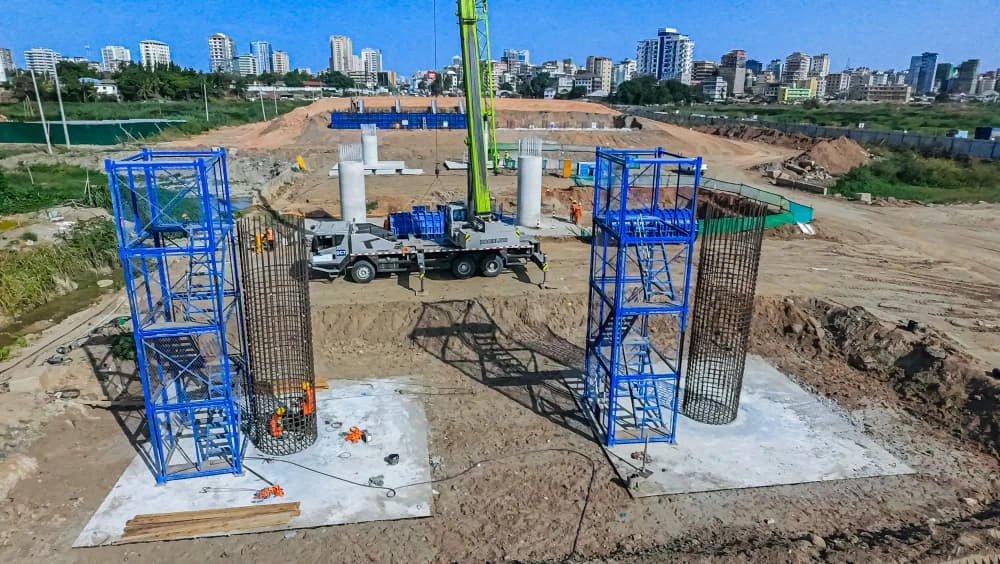
Rising 15.5 metres above sea level and eight metres above the existing road level, the new bridge's elevation clears the Msimbazi River's flood profile at the flows that the seven closure events of the past decade represent and at the higher flows that the urbanisation of the catchment area and the climate trajectory are expected to produce in the coming decades, providing a permanent rather than a temporary solution to the flood vulnerability that the current structure's near-ground-level clearance creates. The deep foundation engineering that the project required, with piles reaching the stable geological formations beneath the Jangwani Valley's unstable floodplain soils, reflects the same recognition that the structure must be built for conditions that the surface geology does not naturally accommodate, requiring the kind of foundational investment that distinguishes infrastructure designed to last from infrastructure designed to meet minimum current specifications.
The project area is 1.2 kilometres long, with the bridge itself being 390 metres long and 41 metres wide, and the project also includes infrastructure for pedestrians and cyclists as well as a Bus Rapid Transit station that will serve passengers in the area. The BRT station inclusion is the detail that most directly expresses the project's multi-modal urban transport ambition, because integrating a dedicated BRT lane and station into the bridge structure means that the Jangwani crossing becomes part of the Dar es Salaam Rapid Transit network's operational reliability rather than its most frequent disruption point, converting what has been the BRT system's most vulnerable flood-risk crossing into a structure designed to keep the bus network operational through the rain events that have historically suspended it.
The Urban Economic Redesign That the Bridge Enables
The Msimbazi Basin Development Project's scope extends significantly beyond the Jangwani Bridge construction into the urban economic development that flood risk elimination makes possible across the valley floor that currently sits in the dead zone created by the combination of flood vulnerability, underinvestment, and land use uncertainty that characterises floodplain areas in rapidly growing African cities whose urban planning frameworks have not caught up with the development pressure bearing down on every available piece of urban land.
The project will establish the Msimbazi city park and redevelopment area to reduce the risk of encroachment and allow for recreational and low-carbon and resilient real estate development, while improving the degraded river channel, recontouring the river and flood plain to improve flow capacity and allow for floodwater retention, and reducing degradation of the Msimbazi watershed. The city park component is the element of the project that most directly addresses the land activation logic: a Msimbazi valley floor that is managed as a formal green space rather than an informal encroachment zone, protected from flood risk by the upstream engineering interventions that the project is funding, becomes an urban asset whose value to the surrounding residential and commercial areas appreciates as the park infrastructure is established and as the land use certainty that formal designation provides attracts the investment that informal status and flood risk have historically deterred.
The institutional framework that the World Bank project is funding alongside the physical infrastructure, described as establishing the Msimbazi Special Area with an institutional structure to sustainably manage land use and development, is the governance dimension that determines whether the urban economic redesign the project is attempting persists over time or whether the encroachment pressures and flood risk dynamics return as the city grows and the project's management attention recedes, because the physical infrastructure of a bridge and a park can be constructed in a defined period while the governance systems that maintain their integrity and enable the economic development they are designed to anchor must operate continuously across the decades of urban growth that lie ahead.
The Implementation Reality and the Compressed Timeline
The World Bank's Mid-Term Review mission of September and October 2025 confirmed that despite delays in implementation the project is expected to achieve its development objective, while simultaneously noting that the compressed timeline resulting from those delays leaves no margin for further slippage, a qualification whose operational significance is that the Jangwani Bridge completion timeline, which the construction contract has targeted for a 24-month construction period from signing, must be managed with the close monitoring and continuous oversight that the MTR document explicitly identifies as necessary to keep the works on track.
Out of the total procurement budget of approximately USD 220 million, the total value of procurement contracts signed by the Mid-Term Review was USD 70.67 million, including the construction contract for the Jangwani Bridge at USD 60 million, the supervision consultancy at USD 5 million, and institutional support contracts totalling the remainder. The USD 70.67 million contracted against USD 220 million budgeted as of October 2025 indicates that the project's procurement pipeline has a significant volume of contracting still to be completed for the valley development components that surround the bridge itself, and the speed at which those contracts are awarded and mobilised will determine whether the broader urban development ambition of the Msimbazi project advances in parallel with the bridge construction or follows it in a sequential manner that delays the land activation and economic development outcomes that the project's full scope is designed to deliver.
The CERC activation that the MTR document references, in which the Contingency Emergency Response Component was activated across four World Bank projects simultaneously in Tanzania, reflects the 2023 and 2024 flood events that caused direct damage to the Msimbazi basin and accelerated the urgency of the project's delivery timeline, converting what had been a planned infrastructure investment into a partially emergency response whose activation has introduced additional complexity into the project management alongside the standard construction management challenges that a USD 60 million river crossing in unstable floodplain soil represents.
The Dar es Salaam Urban Context
With an expanding population estimated at over seven million, Dar es Salaam is the largest city in East Africa, surpassing the five million estimated for Nairobi and ranking fifth largest in Africa, with vehicle numbers growing and existing infrastructure struggling to cope with frequent delays. The urban growth context that makes the Jangwani Bridge investment urgent also makes its economic significance compound over time, because a city growing at Dar es Salaam's rate adds residents and vehicles faster than infrastructure can be incrementally upgraded, meaning that each year of delay in the Jangwani crossing's improvement represents not simply the continuation of a historical problem but the deepening of it as the population and freight volumes that the crossing must serve continue to grow against a capacity that remains fixed until the new bridge is completed.
The Msimbazi Basin Development Project is one component of the broader Dar es Salaam Metropolitan Development Project whose ambition is to address the urban infrastructure, governance, and land management challenges that a city of seven million people growing toward ten million requires, and the Jangwani Bridge's position within that broader programme is as the most urgent and most economically impactful single infrastructure element rather than as a standalone project whose significance is limited to the 1.2-kilometre corridor it occupies, because removing the most frequent and most costly single infrastructure failure point in Dar es Salaam's transport network is the intervention whose economic return is most immediately measurable in the logistics costs, the transit reliability, and the land value dynamics that the Morogoro Road corridor's performance determines for the 1.6 million people whose economic geography is organised around it.
The Bottom Line
The Jangwani Bridge is the most consequential single infrastructure investment currently under construction in Dar es Salaam, not because a 390-metre bridge is inherently transformative but because the corridor it carries has failed seven times in ten years and its failure has imposed a compounding and recurring economic cost on East Africa's largest city that the new structure is designed to eliminate permanently rather than manage temporarily, while the Msimbazi valley development programme that surrounds the bridge investment converts flood risk elimination into an urban economic development opportunity whose city park, land use governance, and redevelopment area components determine whether the bridge's connectivity benefit is captured in sustained investment, formal economic activity, and improved land values across the valley floor or whether the freed-up urban potential is lost to encroachment, informal development, and the governance gaps that African cities' rapid growth consistently exploits ahead of the planning systems designed to manage it.
 Uchumi360
Business Intelligence
Uchumi360
Business Intelligence
Msimbazi Basin Development Project Website TANROADS March 2026. Daily News Jangwani Bridge Work Brings Hope August 2025. World Bank Msimbazi Basin Development Project Brief. Construction Review Online Jangwani Bridge Project Tanzania. World Bank Msimbazi Basin Development Project Mid-Term Review October 2025. Global Highways New Tanzania Bridge. TanzaniaInvest World Bank Loan Jangwani Bridge. Seetao USD 35 Million New Bridge Tanzania. World Bank Press Release New Financing Flood Resilience Dar es Salaam October 2022. Uchumi360 Tanzania Infrastructure Speed Analysis April 2026. Uchumi360 Vision 2050 Growth Requirements Analysis April 2026. Data reflects information available to April 2026.
Uchumi360 covers business, investment, and economic policy across East, Central, and Southern Africa.
For the serious reader
You read to the end. That places you in a small group.
Uchumi360 is built for readers who demand precision over speed, structure over sentiment, and analysis that holds uncomfortable conclusions rather than softening them. If this work sharpens how you think about Africa's economy, help us keep building the infrastructure behind it.
Institutional Partners
Commission intelligence. Shape the conversation.
Uchumi360 works with development finance institutions, investment firms, sovereign bodies, and strategic organisations across the coverage region. Institutional partnership unlocks:
- Commissioned sector and country intelligence reports
- Branded research series under your institution's authority
- Exclusive data briefings for internal strategy teams
- Speaking and editorial presence at Uchumi360 events
- Co-published investment outlooks for your markets
Support Our Work
Independent analysis has a cost. Help us bear it.
Uchumi360 does not carry advertising. It does not take editorial direction from sponsors. Every article is produced without commercial compromise. Your contribution funds the reporting, research, and editorial infrastructure that keeps this analysis free from influence.
Secure checkout: One-time and monthly support are processed securely.
Stay Connected
Keep up with every new insight.
Follow our latest analysis, policy coverage, and market intelligence as soon as it is published. If you need something specific, reach out directly and we will point you to the right research.
