

Zanzibar Is Building a USD 300 Million Deep-Water Port on Its Northern Coast. The Shipping Capacity Is Not the Story. The Economic Model It Is Designed to Replace Is.
Ready
Zanzibar has spent decades building one of the most recognisable tourism brands in the Indian Ocean. The Mangapwani Integrated Port is the infrastructure through which the island is attempting to build something more durable alongside it, a logistics and trade platform whose economic logic is categorically different from the hospitality economy that currently dominates Unguja's revenue base. Whether the port delivers on that logic depends less on its construction than on whether the ecosystem of industrial activity, special economic zones, and regional trade relationships that transform a berth into an economic engine is assembled with the same ambition that the port itself represents.
Zanzibar's current port infrastructure was built for a different era of trade, smaller vessels, lower volumes, and logistics cycles whose pace reflected the island's position as a secondary node rather than a primary one in the Indian Ocean trade system that once made it one of the most commercially significant islands in the world. Malindi Port, which handles the overwhelming majority of cargo moving to and from Unguja today, has shallow draft, limited berth capacity, and congestion patterns that compound turnaround times and raise costs in ways that impose a measurable ceiling on the volume and competitiveness of trade that the island economy can sustain. For an island that depends on external supply chains for virtually every input its population consumes and its tourism industry requires, a port that cannot accommodate modern container vessels is not a marginal operational inconvenience. It is a structural constraint on the economy's productive ceiling.
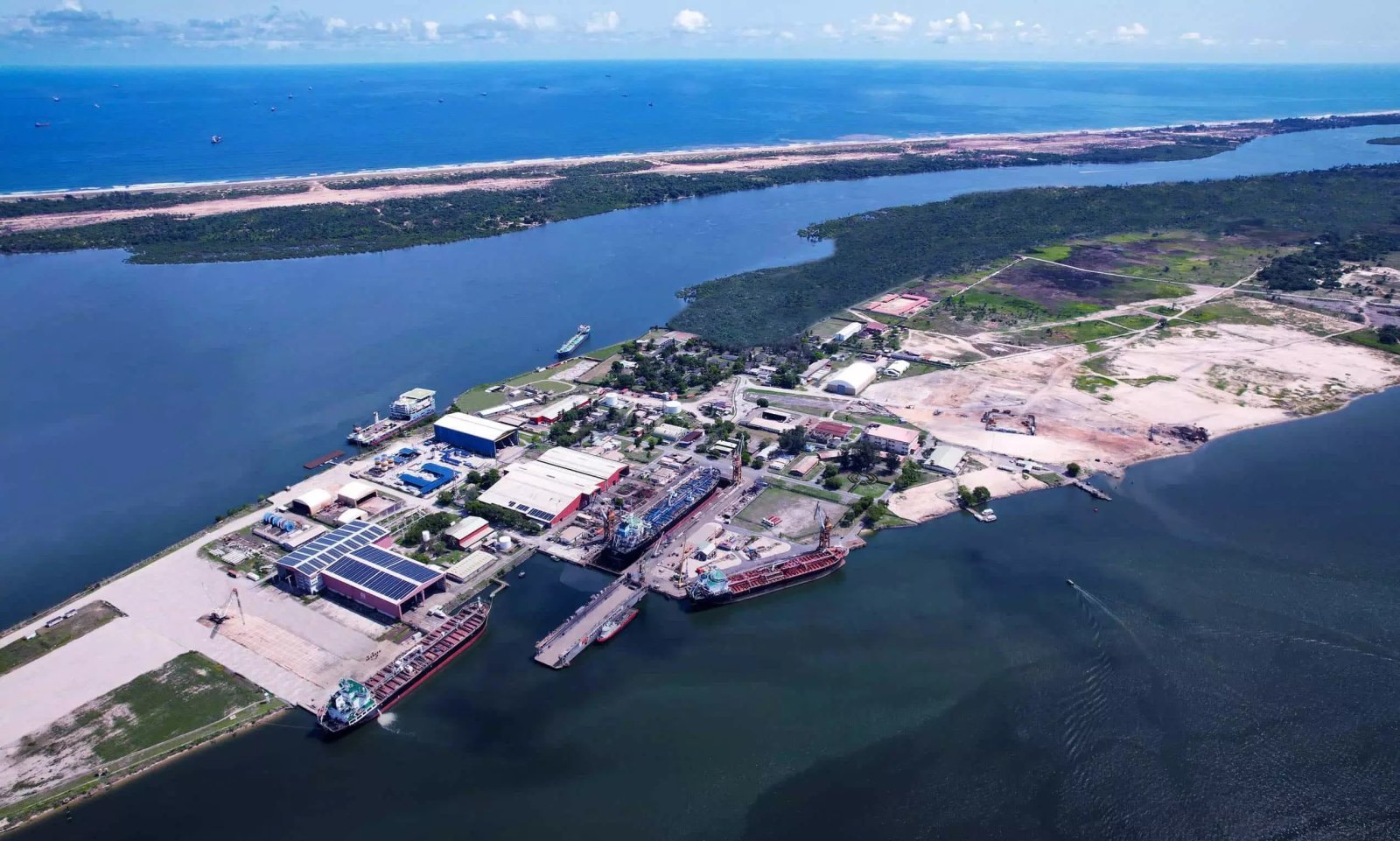
The Mangapwani Integrated Port, currently under construction on the northern coast of Unguja, is the infrastructure response to that constraint. The facility is designed around a 680-metre main berth with water depths of up to 20 metres, specifications that allow it to accommodate large container vessels carrying up to 15,000 containers per voyage, with annual throughput capacity exceeding 200,000 TEUs and over one million tonnes of cargo. At USD 300 million, it is the largest single infrastructure investment in Zanzibar's modern economic history and it is being built with an ambition that goes well beyond replacing Malindi's capacity limitations.
The Difference Between a Port and a Position
The analytical distinction that the Mangapwani project requires is between infrastructure that serves an existing economic role and infrastructure that attempts to create a new one. Most port upgrades fall into the first category. They are built to handle more of what is already moving through a gateway whose commercial function is already established. Mangapwani is being designed for the second category, and understanding why changes how its risk profile and its return profile should be assessed.
Zanzibar's existing economic model generates revenue primarily through tourism, which is a consumption sector that produces foreign exchange, employment in hospitality and services, and the ancillary economic activity that visitor spending supports, but which does not build the industrial depth, logistics capability, or manufactured export capacity that makes an economy structurally resilient across commodity and demand cycles. The island's dependence on tourism revenue is not a failure of policy ambition. It reflects the genuine competitive advantages that Zanzibar's geography, climate, cultural heritage, and natural assets provide in the global tourism market. But tourism revenue alone does not create the economic diversification that insulates a small island economy from the external shocks, whether pandemic disruptions, geopolitical events, or global demand contractions, that periodically collapse visitor numbers regardless of how well the destination is managed.
A deep-water port capable of handling transshipment, the routing of cargo through Zanzibar to other regional destinations, is the infrastructure that repositions the island from a trade endpoint into a trade intermediate. The economic value of that repositioning is substantial because transshipment generates revenue from cargo that is not destined for the local market, effectively monetising Zanzibar's geographic position in the Indian Ocean rather than simply its capacity to absorb its own import volumes. Ports that capture transshipment flows generate handling fees, storage revenues, fuel sales, and the ancillary services demand that sustains logistics businesses, warehousing operations, and the cold chain infrastructure that high-value cargo requires. That economic activity is categorically different in character from tourism revenue because it is driven by trade flows that persist regardless of whether Zanzibar is fashionable as a destination in any given year.
The Scale Economics That Change the Cost Structure
The specification of 20-metre berth depth is not a technical detail at the margin of the project's commercial logic. It is the threshold above which global shipping lines can deploy their largest vessel classes, and the ability to attract those deployments determines the cost per container that Zanzibar's import and export economy faces. Larger vessels distribute fixed voyage costs across more containers, which reduces the unit shipping cost that ultimately flows through to import prices, export competitiveness, and the margins of every business whose supply chain touches the port. A facility that can only accommodate smaller vessels is locked into the higher unit cost structure that those vessels impose, and in a competitive regional shipping environment where Mombasa, Dar es Salaam, and Djibouti are all investing in capacity expansion, a port that cannot compete on vessel size cannot compete on cost, and a port that cannot compete on cost cannot compete for the cargo flows that determine whether its capacity is utilised.
The 200,000 TEU annual capacity figure is equally important as an utilisation threshold rather than simply as a headline specification. Port economics are intensely volume-sensitive because fixed infrastructure costs, berth maintenance, equipment, operating staff, and debt service on construction financing, are distributed across throughput. A port operating at 40 percent of its designed capacity is not generating 60 percent less revenue than a fully utilised facility. It is generating substantially less than that because the fixed cost base remains largely unchanged regardless of throughput. Reaching utilisation levels that justify the USD 300 million capital commitment requires generating cargo volumes that Zanzibar's domestic trade alone cannot supply, which is precisely why the transshipment logic and the special economic zone development are not optional add-ons to the port project but essential preconditions for its financial viability.
The Energy Architecture That Most Analyses Miss
The Mangapwani project includes fuel storage capacity and energy supply infrastructure as integrated components of the port development, and this dimension of the project carries analytical significance that the standard infrastructure coverage of the project has largely overlooked. Zanzibar's economy faces three linked constraints whose interaction compounds the cost of doing business on the island in ways that go beyond what any single constraint would impose in isolation: port congestion raises logistics costs, high fuel prices raise operating costs across every sector, and energy unreliability raises the capital requirements of any business that needs consistent power for cold storage, manufacturing, or processing operations.
A port development that addresses logistics infrastructure alone would leave the fuel cost and energy reliability constraints in place, which would limit the range of economic activities that could commercially locate around the new facility. The integration of fuel storage and energy infrastructure into the port design reflects an understanding that the economic ecosystem the port is supposed to anchor requires all three constraints to be addressed simultaneously rather than sequentially. Cold chain logistics, which is among the highest-value activities that a regional trade hub can support, is entirely dependent on reliable, affordable energy. Light manufacturing, which is the category of industrial activity most likely to locate in a special economic zone around a new deep-water port, requires energy reliability that grid instability cannot provide. The port's energy infrastructure is therefore not a convenience feature for vessel operations. It is the enabling condition for the broader economic ecosystem that justifies the port's scale.
The Cold Chain Argument and Its Regional Reach
East Africa's agricultural economy produces significant volumes of fresh produce, flowers, fish, and perishable goods whose access to global markets is constrained by cold chain infrastructure gaps at every point in the export logistics chain from farm to vessel. A port facility with purpose-built refrigerated cargo handling capability, positioned on an island with direct Indian Ocean access and proximity to the Middle Eastern markets that import substantial volumes of East African agricultural products, has a specific and commercially grounded opportunity to position itself as the regional cold chain logistics hub that the sector currently lacks.
The trade flows that this positioning would serve are not speculative. Kenya's fresh flower exports, Tanzania's fish exports, the horticultural production from across the East African region that currently moves through congested facilities at Mombasa and Dar es Salaam with cold chain handling that is inadequate relative to the quality standards that premium export markets require, all represent cargo whose routing could commercially shift to a purpose-built facility offering superior cold chain capability. The Middle Eastern import market for East African perishables is large, geographically close by Indian Ocean standards, and growing as Gulf populations increase their consumption of fresh produce from African sources. Zanzibar's geographic position in the middle of that trade route is a genuine competitive asset for cold chain logistics in ways that are more specific and more commercially grounded than the general transshipment argument.
The Regional Port Competition Zanzibar Is Entering
Mangapwani is not being built into a static competitive environment. East Africa's port system is actively expanding across multiple nodes simultaneously, and Zanzibar is entering a competition whose existing players have established cargo relationships, hinterland connectivity, and institutional track records that a new facility will not immediately match. Mombasa's position serving Kenya and the landlocked economies of Uganda, Rwanda, Burundi, and eastern DRC is anchored by the Northern Corridor's road and rail infrastructure that took decades to develop and that cannot be replicated by port construction alone. Dar es Salaam's position serving Tanzania and the Central Corridor's landlocked hinterland is being reinforced by the Standard Gauge Railway whose freight services launched in 2025. Djibouti's position serving Ethiopia, one of Africa's largest economies by population, is institutionally entrenched through the Addis Ababa-Djibouti Railway and the long-standing commercial relationships between Ethiopian importers and Djiboutian logistics operators.
Zanzibar's competitive entry into this system is credible precisely because the existing nodes are capacity-constrained rather than underutilised. Mombasa and Dar es Salaam are both operating near or at capacity across peak periods, which creates genuine demand for additional regional port capacity that a modern, efficiently operated new facility can capture. The question is not whether demand exists for additional East African port capacity. It does. The question is whether Mangapwani can build the operational efficiency, the shipping line relationships, and the cargo volume consistency that transforms a facility with available capacity into a port that global logistics operators route cargo through as a matter of commercial preference rather than as an overflow option when primary ports are congested.
The Special Economic Zone Imperative
Port infrastructure does not generate industrial economic transformation in isolation from the commercial ecosystem that surrounds it. The history of large-scale port investments across the developing world is extensively documented with examples of facilities that were built to specification, opened on schedule, and then operated at chronic underutilisation because the industrial activity, the warehousing operations, the processing facilities, and the re-export businesses that were supposed to generate the cargo volumes justifying the investment did not materialise at the pace or scale that the project's financial model required.
The Mangapwani project is being developed alongside plans for logistics hubs and special economic zones, and the relationship between those components is not sequential but interdependent in ways that the project's development timeline needs to reflect. Special economic zones generate the industrial tenants whose production and distribution requirements generate cargo. Cargo generates the vessel calls that establish the port's operational rhythm and its attractiveness to shipping lines. Shipping line frequency generates the import and export options that make the SEZ attractive to additional industrial tenants. The flywheel requires all of its components to be operational at sufficient scale simultaneously, which means that the port construction timeline and the SEZ development timeline need to be coordinated rather than treated as independent workstreams that will eventually connect.
Tanzania's Bagamoyo Special Economic Zone, which Uchumi360 documented in its April 2026 analysis of the HWTZ industrial complex, is the most directly relevant model for the Zanzibar SEZ development because it demonstrates both the potential and the execution challenge of building industrial activity around new port infrastructure in a Tanzanian regulatory and investment environment whose conversion efficiency between approved investment and operational production is still developing.
The Mainland Coordination Question
Zanzibar's port development cannot be analysed in isolation from mainland Tanzania's port and logistics infrastructure without producing an incomplete picture of both the opportunity and the risk. Dar es Salaam Port, the Tanzania SGR's Central Corridor freight system, and the planned Bagamoyo port development together constitute a logistics infrastructure architecture whose coordination with Mangapwani will determine whether Tanzania emerges from the current infrastructure investment cycle with a coherent, complementary port system that serves different market segments efficiently, or with competing facilities that fragment cargo flows and undermine each other's utilisation economics.
The coordination question is institutional as much as it is geographic. Zanzibar operates under a semi-autonomous government structure within the United Republic of Tanzania, with its own administration, its own budget, and its own development priorities that do not always align precisely with mainland Tanzania's infrastructure planning frameworks. A port development of Mangapwani's scale and ambition requires active coordination with the Tanzania Ports Authority, with the SGR's freight operations management, and with the investment promotion frameworks of mainland Tanzania's special economic zones, in ways that the semi-autonomous governance structure makes more complex than a single jurisdiction port development would be.
The coordination opportunity is equally real. A Zanzibar port specialised in cold chain logistics, transshipment, and Indian Ocean trade flows, operating in complementary relationship with a Dar es Salaam port specialised in bulk cargo and Central Corridor container traffic, would give Tanzania a port system whose combined coverage of the regional trade landscape is more competitive than either facility alone. Whether that complementary relationship is designed deliberately or emerges accidentally, if it emerges at all, is the governance question whose answer will most significantly determine Mangapwani's long-term economic contribution.
The Honest Assessment
Zanzibar's USD 300 million port investment is analytically sound in its physical specifications, commercially credible in its identification of the trade flows it intends to serve, and strategically coherent in its ambition to reposition the island economy beyond its current tourism dependence. The berth depth, the throughput capacity, the cold chain infrastructure, and the transshipment orientation are all correctly calibrated for the regional shipping market that Mangapwani is designed to enter.
The risks are equally real and they are not engineering risks. Construction at this scale and specification is technically straightforward for the international contractors who build deep-water port facilities across the developing world on a routine basis. The risks are commercial and institutional. Achieving the cargo volumes that justify 200,000 TEU annual capacity requires shipping line relationships, SEZ industrial tenants, cold chain logistics operators, and regional trade routing decisions by importers and exporters across East Africa that cannot be mandated by infrastructure investment alone. Each of those commercial relationships needs to be actively developed, competitively priced, and institutionally maintained across the decade-long timeline over which a port investment of this scale realises its return.
Zanzibar's economic transformation from a tourism-dependent island to a logistics and trade platform is a coherent and achievable ambition. The Mangapwani port is the necessary infrastructure for that transformation. It is not, by itself, sufficient for it. The difference between a modern port that changes an island's economic model and a modern port that serves an unchanged economic structure at higher capacity is not the quality of the berth. It is the quality of the institutional ecosystem, the investment climate, and the commercial relationships that determine what happens in the kilometres around it.
That is the work that the construction timeline does not capture and that Zanzibar's development planners cannot defer until the berths are operational.
 Uchumi360
Business Intelligence
Uchumi360
Business Intelligence
Zanzibar Port Authority Mangapwani Integrated Port Project Documentation. Tanzania Ports Authority Annual Report 2024/25. African Development Bank East Africa Trade Logistics Assessment 2025. Uchumi360 Bagamoyo Industrial Complex Analysis April 2026. Uchumi360 Tanzania SGR Freight Operations Analysis June 2025. Uchumi360 Dar es Salaam Port Expansion Coverage March 2026. East Africa Community Trade and Logistics Framework Documentation. Data reflects information available to April 2026.
Uchumi360 covers business, investment, and economic policy across East, Central, and Southern Africa.
For the serious reader
You read to the end. That places you in a small group.
Uchumi360 is built for readers who demand precision over speed, structure over sentiment, and analysis that holds uncomfortable conclusions rather than softening them. If this work sharpens how you think about Africa's economy, help us keep building the infrastructure behind it.
Institutional Partners
Commission intelligence. Shape the conversation.
Uchumi360 works with development finance institutions, investment firms, sovereign bodies, and strategic organisations across the coverage region. Institutional partnership unlocks:
- Commissioned sector and country intelligence reports
- Branded research series under your institution's authority
- Exclusive data briefings for internal strategy teams
- Speaking and editorial presence at Uchumi360 events
- Co-published investment outlooks for your markets
Support Our Work
Independent analysis has a cost. Help us bear it.
Uchumi360 does not carry advertising. It does not take editorial direction from sponsors. Every article is produced without commercial compromise. Your contribution funds the reporting, research, and editorial infrastructure that keeps this analysis free from influence.
Secure checkout: One-time and monthly support are processed securely.
Stay Connected
Keep up with every new insight.
Follow our latest analysis, policy coverage, and market intelligence as soon as it is published. If you need something specific, reach out directly and we will point you to the right research.
