
Economy Expected to Reach TZS 258 Trillion by 2030. What Must Go Right?
Ready
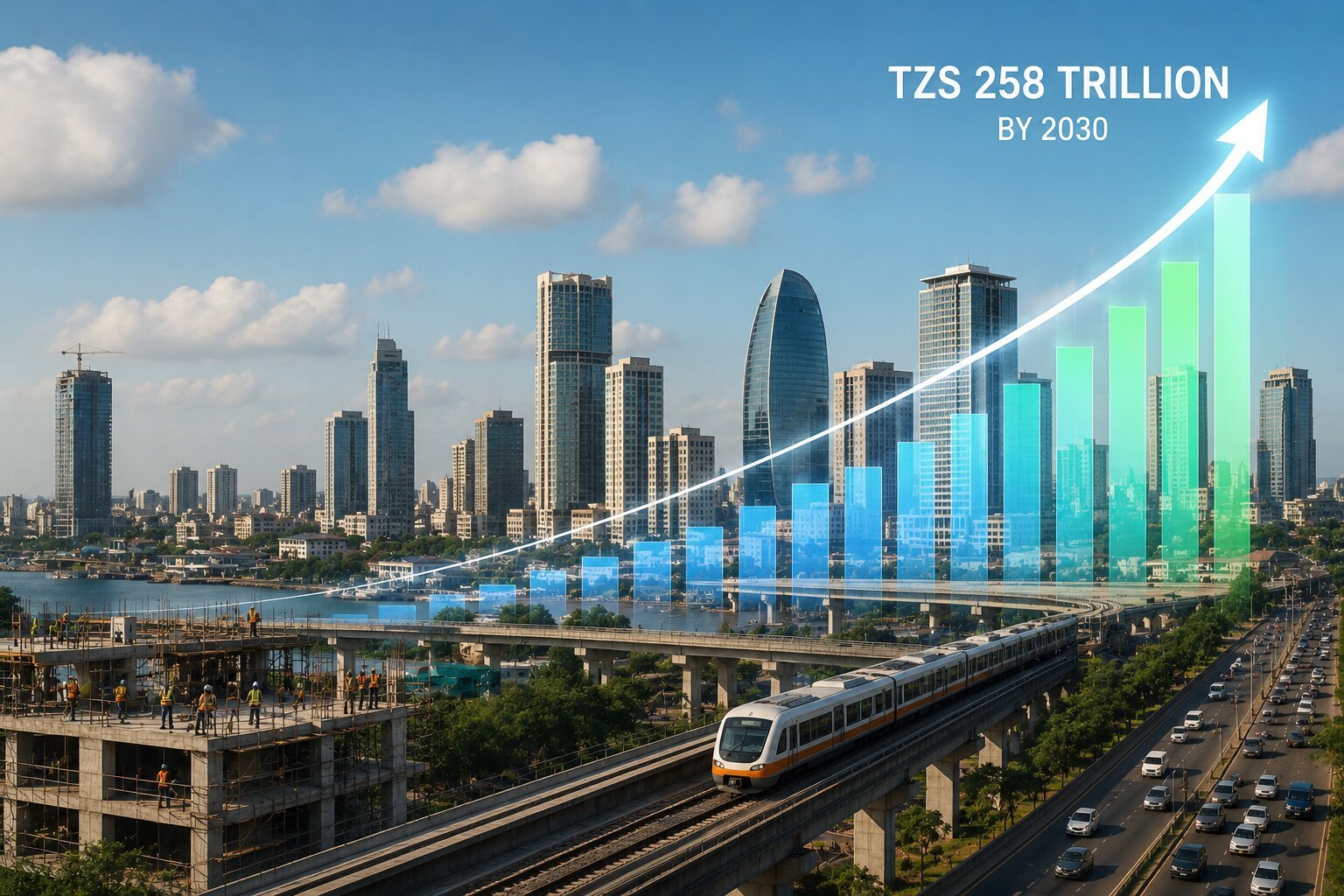
Tanzania GDP trajectory from National Development Plan 2026/27: TZS 186,103 billion (2025) → TZS 197,842 billion (2026) → TZS 210,937 billion (2027) → TZS 225,645 billion (2028) → TZS 241,578 billion (2029) → TZS 258,954 billion (2030). Real growth rate trajectory: 5.9 percent (2025) → 6.3 percent (2026) → 6.6 percent (2027) → 7.0 percent (2028) → 7.1 percent (2029) → 7.2 percent (2030). For this to materialise: private sector investment must sustain TZS 60+ trillion annually, tax revenue must reach 18 percent of GDP by 2030, agricultural growth must reach 10 percent annually, manufacturing must expand from 5.9 to 8 percent of GDP, tourism must expand to 35 percent of foreign exchange earnings, mining must reach 12.5 percent of GDP. Primary risks identified: weak implementation coordination, shortfall in private sector investment, global economic instability, inadequate digital governance readiness, and regional political disruption affecting trade and investment. National debt sustainability: all DSA indicators within limits, Moody's B1 stable, Fitch B+ stable. Reaching TZS 258 trillion by 2030 is Tanzania's plan. Whether it becomes Tanzania's outcome depends on whether the institutional machinery the plan is simultaneously trying to build can execute the plan itself before the plan needs those institutions to be ready. That circularity is the fundamental challenge of every ambitious national development plan. Tanzania has five years to resolve it.
DAR ES SALAAM — Tanzania's nominal GDP is projected to reach TZS 258,954 billion by 2030 from TZS 186,103 billion in 2025, according to the National Development Plan 2026/27. The trajectory implies compound annual nominal GDP growth of approximately 6.9 percent in real terms over six years, against the 5.9 percent actual growth achieved in 2025 and a consistent upward trend since 2021.
The seven things that must go right
Private sector investment at TZS 60 trillion annually is the foundational requirement. The 70:30 private-public ratio has held consistently since 2018, with private sector investment growing from TZS 28.7 trillion to TZS 54.0 trillion. Maintaining the trajectory to TZS 60 trillion in FY2026/27 and sustaining growth toward the 2030 target requires the business environment reforms, FDI attraction, and PPP pipeline execution the plan describes. If private sector investment growth stalls at the 2024 level rather than accelerating, the GDP trajectory falls short by an amount proportional to the investment shortfall.
Tax revenue at 18 percent of GDP by 2030 is the fiscal foundation. The FY2026/27 target of 13.7 percent, rising from 13.2 percent in FY2025/26, already requires TRA to sustain the 105 percent collection performance it demonstrated in FY2025/26 while also expanding the tax base through Universal Billing System deployment and formal economy expansion. Getting from 13.7 to 18 percent over four years requires the structural formalisation of the 94.2 percent informal economy to reduce materially.
Agricultural growth at 10 percent annually by 2030 requires the irrigation expansion from 983,466 to 5,000,000 hectares to deliver productivity improvement in proportion to the investment. Irrigation at the target scale, combined with better seeds, fertiliser, pest management, and post-harvest infrastructure, is the mechanistically correct path to agricultural growth acceleration. The question is whether the implementation capacity at district and irrigation authority level can execute at the required pace.
Manufacturing expansion from 5.9 to 8 percent of GDP requires TISEZA's approval pipeline converting to operating production at a substantially higher rate than the current 397,953 manufacturing workers can achieve. An additional 600,000 to 800,000 manufacturing sector workers by 2030 is implied by the sectoral targets, which requires both the investment to materialise and the skills pipeline to produce qualified workers for the factories being built.
Tourism reaching 35 percent of foreign exchange earnings from 27 percent in 2025 requires both arrival growth toward 5 million international visitors and the average revenue per visitor to rise through product quality improvement and the higher-spending MICE and luxury market segments the plan specifically targets.
The risks the plan names
The plan's risk register identifies five categories whose materialisation would disrupt the trajectory. Institutional coordination weakness between ministries remains the historically most consistent plan execution risk. Private sector underinvestment below the TZS 60 trillion projection is the largest single number risk. Global economic instability including commodity price collapse, interest rate spikes, or trade disruption could reduce export revenues, FDI inflows, and import costs simultaneously. Inadequate digital governance readiness in the public service limits the institutional reform delivery that Vision 2050's governance model requires. Regional political instability in neighbouring countries could disrupt the Central Corridor transit trade and investment confidence on which Tanzania's regional hub positioning depends.
The debt position that gives Tanzania room
The starting external debt position provides fiscal headroom. Tanzania's national debt reached TZS 114,342.1 billion by March 2026, growing 8.97 percent from TZS 104,931.1 billion in March 2025. All DSA indicators remain within thresholds: present value of external debt at 24.4 percent of GDP against a 40 percent limit, external debt service as a share of export earnings at 12.8 percent against a 15 percent limit, and total debt including domestic at 39.6 percent of GDP against a 55 percent limit. Moody's B1 stable outlook confirmed in February 2026 and Fitch B+ stable confirmed in March 2026 both reflect a credible external assessment of Tanzania's debt sustainability.
The combination of manageable debt, a consistent growth trend, and a structurally improving external position means Tanzania's path to TZS 258 trillion in nominal GDP by 2030 is not a fantasy. It is a stretch target whose achievement depends on the execution quality that transforms development plans into development outcomes.
 Uchumi360
Business Intelligence
Uchumi360
Business Intelligence
Uchumi360 covers business, investment, and economic policy across East, Central, and Southern Africa.
For the serious reader
You read to the end. That places you in a small group.
Uchumi360 is built for readers who demand precision over speed, structure over sentiment, and analysis that holds uncomfortable conclusions rather than softening them. If this work sharpens how you think about Africa's economy, help us keep building the infrastructure behind it.
Institutional Partners
Commission intelligence. Shape the conversation.
Uchumi360 works with development finance institutions, investment firms, sovereign bodies, and strategic organisations across the coverage region. Institutional partnership unlocks:
- Commissioned sector and country intelligence reports
- Branded research series under your institution's authority
- Exclusive data briefings for internal strategy teams
- Speaking and editorial presence at Uchumi360 events
- Co-published investment outlooks for your markets
Support Our Work
Independent analysis has a cost. Help us bear it.
Uchumi360 does not carry advertising. It does not take editorial direction from sponsors. Every article is produced without commercial compromise. Your contribution funds the reporting, research, and editorial infrastructure that keeps this analysis free from influence.
Secure checkout: One-time and monthly support are processed securely. Add payment credentials to enable checkout here.
Stay Connected
Keep up with every new insight.
Follow our latest analysis, policy coverage, and market intelligence as soon as it is published. If you need something specific, reach out directly and we will point you to the right research.
