
The Seven Mega Programmes Expected to Drive Tanzania's Economy Under Vision 2050
Ready
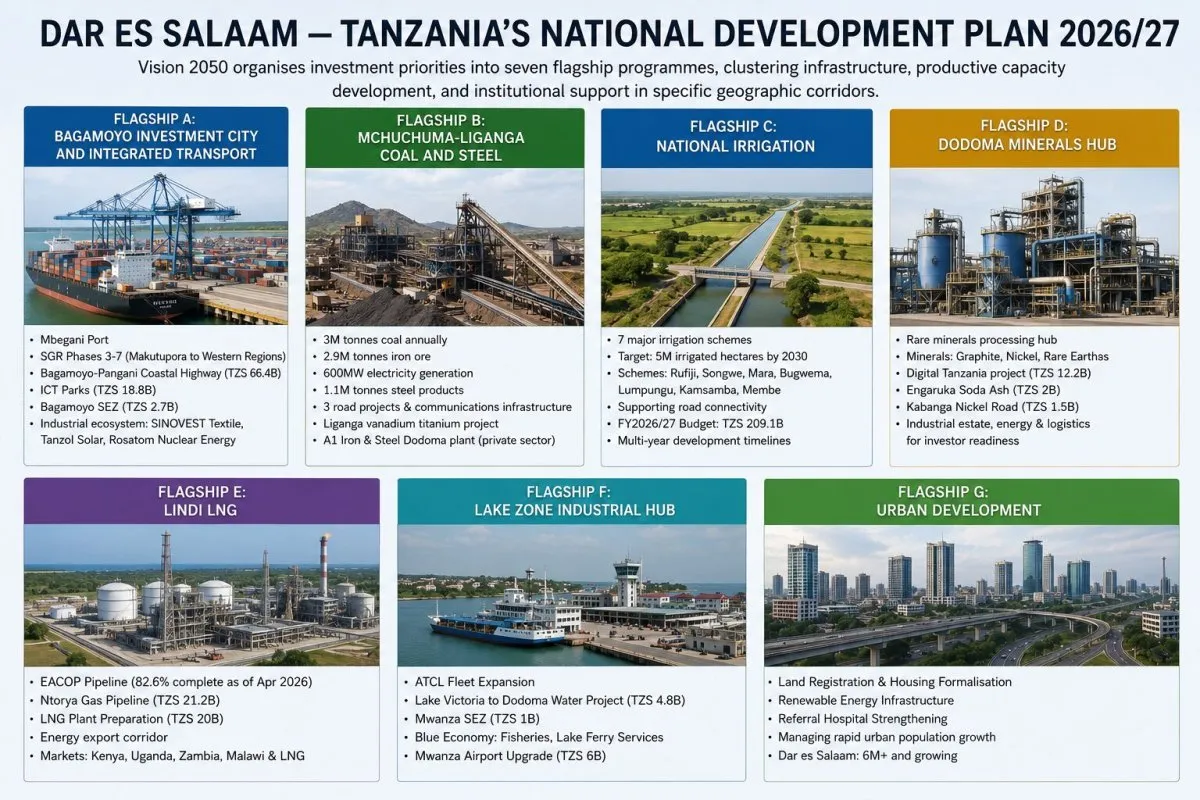
Tanzania's seven flagship programmes: (A) Bagamoyo Investment City and Integrated Transport: Mbegani port, SGR phases 3-7, Bagamoyo-Pangani coastal highway, ICT parks, and Bagamoyo SEZ anchor investments. (B) Mchuchuma-Liganga Coal and Steel Hub: 3 million tonnes annual coal production, 600MW electricity, 2.9 million tonnes iron ore, 1.1 million tonnes steel products, with supporting road and communications infrastructure. (C) National Irrigation and Agricultural Industrialisation: Seven major irrigation schemes covering Rufiji, Songwe, Mara, Bugwema, Lumpungu, Kamsamba, and Membe river systems targeting 5 million hectares by 2030. (D) Dodoma Rare Minerals and Technology Processing Hub: Graphite, nickel, and rare earth processing facilities, national fibre backbone, Kabanga nickel road. (E) Lindi LNG Processing Plant: EACOP completion, Ntorya gas pipeline, LNG plant development. (F) Lake Zone Industrial and Blue Economy Hub: ATCL strengthening, Lake Victoria to Dodoma water project, Mwanza SEZ. (G) National Urban Development Programme: Land surveying and titling, LTIP milki improvement, renewable energy projects, referral hospital strengthening. FY2026/27 budgets total anchor project investment of approximately TZS 4.7 trillion across the seven programmes. The seven flagship programmes are Tanzania's answer to the question that every Vision document must eventually answer: not what we want to build, but where we will build it first, in what sequence, and with whose capital.
DAR ES SALAAM — Tanzania's National Development Plan 2026/27 organises Vision 2050's investment priorities into seven flagship programmes, each designed to cluster related infrastructure investments, productive capacity development, and institutional support in specific geographic corridors rather than distributing them across the country in ways that create too little concentration to generate ecosystem effects.
 Tanzania economic sectors.
Flagship A: Bagamoyo Investment City and Integrated Transport
The Bagamoyo flagship is the most strategically significant, as confirmed by President Samia's SPIEF 2026 declaration of it as Tanzania's number one project. It combines the Mbegani port, SGR phases three through seven extending from Makutupora toward the western regions, the Bagamoyo-Pangani coastal highway at TZS 66.4 billion, ICT parks at TZS 18.8 billion, and the Bagamoyo SEZ at TZS 2.7 billion in the FY2026/27 budget. The SINOVEST textile factory, the Tanzol Solar Manufacturing Complex, and the Rosatom nuclear energy discussions all connect to the Bagamoyo programme's industrial ecosystem ambition.
Flagship B: Mchuchuma-Liganga Coal and Steel
The southern highlands complex targets 3 million tonnes of coal annually, 2.9 million tonnes of iron ore, 600MW of electricity generation, and 1.1 million tonnes of steel products. Supporting infrastructure includes three road projects, communications infrastructure, and the Liganga vanadium titanium project. The A1 Iron and Steel Dodoma plant announced in mid-2026 is the first private sector commitment to the value chain this programme creates, though the plant's Dodoma location means it will source Liganga ore through the transport network rather than as a co-located facility.
Flagship C: National Irrigation
Seven major irrigation schemes targeting 5 million irrigated hectares by 2030 represent the agricultural transformation investment whose scale is unprecedented in Tanzania's history. The combined budget across Rufiji, Songwe, Mara, Bugwema, Lumpungu, Kamsamba, and Membe schemes, alongside supporting road connectivity, totals TZS 209.1 billion in FY2026/27 with multi-year development timelines.
Flagship D: Dodoma Minerals Hub
The rare minerals processing hub in Dodoma clusters graphite, nickel, and rare earth processing infrastructure alongside the Digital Tanzania project at TZS 12.2 billion, Engaruka soda ash at TZS 2 billion, and the Kabanga nickel road at TZS 1.5 billion. The hub logic is to provide the industrial estate, energy infrastructure, and logistics connectivity that foreign investors in mineral processing require before committing capital to processing facilities.
Flagship E: Lindi LNG
The EACOP pipeline at 82.6 percent completion by April 2026, the Ntorya gas pipeline at TZS 21.2 billion, and LNG plant preparation at TZS 20 billion form the energy export corridor whose completion is expected to generate significant foreign exchange earnings from gas exports to Kenya, Uganda, Zambia, and Malawi alongside the LNG export market.
Flagship F: Lake Zone Industrial Hub
ATCL fleet expansion, the Lake Victoria to Dodoma water project at TZS 4.8 billion, and the Mwanza SEZ at TZS 1 billion anchor a hub whose Blue Economy dimension includes the expanded fisheries capacity, lake ferry services, and the Mwanza airport upgrade at TZS 6 billion.
Flagship G: Urban Development
Land registration, housing formalisation, renewable energy infrastructure, and referral hospital strengthening serve the urban population growth whose management is critical as Tanzania's cities, led by Dar es Salaam at 6 million people and growing, expand at rates whose infrastructure requirements the current budget is attempting to keep pace with.
 Uchumi360
Business Intelligence
Uchumi360
Business Intelligence
Uchumi360 covers business, investment, and economic policy across East, Central, and Southern Africa.
For the serious reader
You read to the end. That places you in a small group.
Uchumi360 is built for readers who demand precision over speed, structure over sentiment, and analysis that holds uncomfortable conclusions rather than softening them. If this work sharpens how you think about Africa's economy, help us keep building the infrastructure behind it.
Institutional Partners
Commission intelligence. Shape the conversation.
Uchumi360 works with development finance institutions, investment firms, sovereign bodies, and strategic organisations across the coverage region. Institutional partnership unlocks:
- Commissioned sector and country intelligence reports
- Branded research series under your institution's authority
- Exclusive data briefings for internal strategy teams
- Speaking and editorial presence at Uchumi360 events
- Co-published investment outlooks for your markets
Support Our Work
Independent analysis has a cost. Help us bear it.
Uchumi360 does not carry advertising. It does not take editorial direction from sponsors. Every article is produced without commercial compromise. Your contribution funds the reporting, research, and editorial infrastructure that keeps this analysis free from influence.
Secure checkout: One-time and monthly support are processed securely. Add payment credentials to enable checkout here.
Stay Connected
Keep up with every new insight.
Follow our latest analysis, policy coverage, and market intelligence as soon as it is published. If you need something specific, reach out directly and we will point you to the right research.
