
Rwanda Registered USD 2.62 Billion Across 799 Projects in 2025. The Volume Is Not the Story. The System Behind the Allocation Is.
Ready
Most investment data is read as a volume story. How much capital came in, how many projects registered, how many jobs will be created. Rwanda's 2025 figures support a more specific reading: not how much, but where, why, and through what institutional mechanism. The USD 2.62 billion across 799 projects registered by the Rwanda Development Board in 2025 is the output of a system whose architecture is more analytically interesting than the aggregate number that leads every headline about it.
Rwanda registered USD 2.62 billion in investment across 799 projects in 2025, with FDI inflows reaching USD 872.9 million, a 21.8 percent increase year on year. The sectoral concentration of capital in real estate, manufacturing, and mining is not diversification failure but deliberate sequencing: urbanisation absorbs capital, manufacturing converts density into employment, mining stabilises the external balance. The institutional architecture behind these numbers, including the One Stop Centre's integration of over 400 services, Africa's highest B-READY regulatory framework score, and a fifth consecutive Rule of Law top ranking in Sub-Saharan Africa, is what converts investment attraction into investment retention. Rwanda's 2030 strategy targets doubling private investment to USD 4.6 billion. The test is whether the system that produced 2025's results can scale without losing the execution discipline that made them possible.
The number that leads Rwanda's 2025 investment story is USD 2.62 billion registered across 799 projects, up from 612 projects the previous year, with projected job creation of 38,151 and FDI inflows reaching USD 872.9 million according to the National Bank of Rwanda's 2025 Foreign Private Capital Report. These figures, sourced directly from the Rwanda Development Board's 2025 Annual Report, are strong by any regional standard and exceptional for an economy of Rwanda's size. But reading them as a volume story misses the more analytically consequential dimension of what Rwanda's investment data actually describes when examined at the sectoral, geographic, and institutional level.
The comparison that contextualises Rwanda's performance most precisely is not with a global benchmark but with its immediate regional competitors. Tanzania registered USD 10.95 billion in approved investment capital in 2025, a figure that dwarfs Rwanda's by a factor of four in absolute terms. Kenya's investment attraction numbers, filtered through the NIFC framework and the NSE's deepening capital markets, reflect an economy whose financial services and technology sectors generate investment flows that Rwanda's smaller economy cannot yet match. Uganda's Albertine oil region is drawing capital whose scale relative to GDP will exceed Rwanda's mining investment once first oil production begins in the second half of 2026. On a per-project or per-dollar basis, Rwanda's numbers are not the largest in the region. The question that makes them interesting is not their size but their consistency, their composition, and the institutional mechanism through which registered capital converts into operational investment at rates that the regional peer group has not replicated.
The Sectoral Architecture and What It Is Actually Doing
Rwanda's investment concentration in real estate, manufacturing, and mining, which the RDB Annual Report confirms accounts for over 74 percent of total registered investment, is most commonly interpreted as a diversification gap. The correct interpretation is a sequencing logic that reflects a deliberate macroeconomic design rather than a limited investment menu.
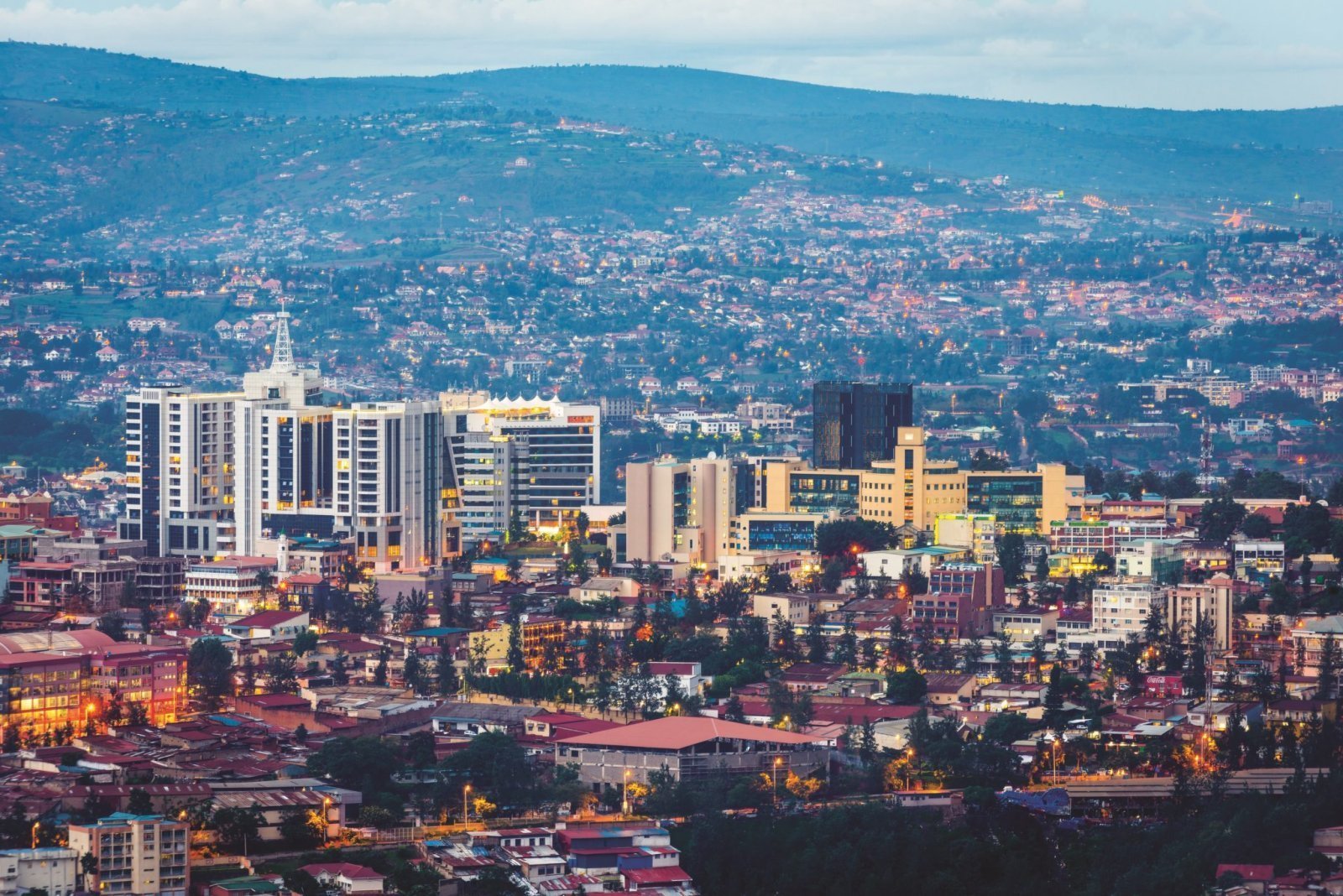
Real estate performs a specific function in a rapidly urbanising economy that monetary data alone cannot capture. Kigali's population is growing at a rate that requires physical infrastructure, residential density, and commercial space faster than any other source of capital can provide them, and real estate investment absorbs that demand while simultaneously creating the urban density that makes manufacturing and services investment viable. A factory that cannot house its workers, a logistics firm that cannot find commercial warehouse space, and a financial services company that cannot lease grade-A office space all face location barriers that real estate investment, concentrated in Kigali, removes. The 65.6 percent geographic concentration of investment in Kigali that the brief identifies as a potential imbalance is therefore better understood as the capital efficiency of agglomeration, where infrastructure cost per unit of economic activity declines as density increases, rather than as a distributional failure.
Manufacturing's role in the sectoral architecture is different and more consequential for the medium term. Despite receiving a smaller share of total capital than real estate, manufacturing accounts for the largest share of projected employment from 2025's registered projects, a proportion that reflects the labour intensity of production relative to property development. According to the RDB Annual Report, the 799 projects registered in 2025 are projected to generate 38,151 jobs. Manufacturing's disproportionate contribution to that employment figure is the mechanism through which Rwanda's urbanisation investment pays its social dividend, converting the density that real estate creates into the formal employment that sustains household income and consumer spending at the scale a growing city requires.
Mining's function in the architecture is the most immediately visible in the export data. Rwanda's mining sector generated USD 869.7 million in mineral exports in 2025, employed over 92,000 people, and advanced value addition through compliant refining of gold, tin, tantalum, and niobium. A total of RWF 75.8 billion in taxes was collected from industrial mining and commercial quarry operations. The sector's contribution to the external balance is the stabilising variable in a small open economy that depends on foreign exchange for the imports its industrialisation programme requires. Mining's emphasis on traceability and value addition, documented across multiple sections of the RDB Annual Report, reflects the same logic that Uchumi360's critical minerals analysis identified as the defining strategic choice for African resource economies: shifting from extraction revenue to processing margin. Rwanda's position in tantalum and gold traceability certification is the most advanced expression of this logic in the East African coverage region.
The FDI Quality Signal That Volume Figures Obscure
Rwanda's FDI figure of USD 872.9 million in 2024, representing a 21.8 percent year-on-year increase, is analytically more significant when examined by composition than by aggregate. The National Bank of Rwanda's Foreign Private Capital Report documents that this growth was driven by equity injections increasing 43.1 percent, retained earnings growing 9.3 percent, and affiliated debt rising 25.4 percent, led by capital-intensive and infrastructure-related firms.
The composition of FDI is a more reliable signal of investor confidence than the volume figure alone because it distinguishes between capital that is committed to long-term productive deployment and capital that retains the optionality of rapid exit. Equity injections at 43.1 percent growth indicate that investors are putting permanent capital into Rwandan enterprises rather than lending to them in forms that can be recalled when conditions change. Retained earnings growth of 9.3 percent indicates that investors already operating in Rwanda are choosing to reinvest their profits within the system rather than repatriating them, which is the most direct available evidence that the return on capital within Rwanda exceeds the return available from redeployment elsewhere. Affiliated debt at 25.4 percent growth, in the context of capital-intensive and infrastructure-related firms, reflects the long-term financing of productive assets rather than speculative flows.
The comparison with Tanzania's investment structure is instructive here. Uchumi360's March 2026 analysis of Tanzania's investment surge documented that 52 percent of Tanzania's registered investment is structured as joint ventures between foreign and domestic partners, which is a strong structural signal. Rwanda's FDI composition signal is different in character but equally significant: rather than describing how investment is structured at entry, it describes how investors behave once inside the system, and the retention and reinvestment data suggests that those already inside are not looking for the exit.
The Institutional Architecture That Makes the Numbers Hold
The figures documented in the RDB Annual Report are not self-generating. They are the output of an institutional architecture whose specific features distinguish Rwanda's investment environment from the regional peer group in ways that require examination rather than summary.
The One Stop Centre's integration of over 400 government services into a single interface is the most frequently cited element of Rwanda's investment facilitation infrastructure, and its operational significance goes beyond the convenience of a single registration point. Business registration can be completed online within six hours, with the Certificate of Incorporation carrying an integrated Tax Identification Number and Social Security Number. One-stop licensing integrates over 20 government institutions into a single application process. The investor aftercare and dispute resolution mechanisms that the brief identifies as resolving 86 percent of investor issues within the year represent the retention focus that distinguishes a mature investment facilitation system from one whose primary orientation is attraction. The RDB Annual Report documents this as a deliberate strategic priority: promotion and implementation are treated as equally important, not as sequential phases where implementation follows after attraction has done its work.
Rwanda's B-READY 2025 results provide the most precise external validation of how this institutional architecture performs relative to international benchmarks. Rwanda recorded Africa's highest score on regulatory framework, Africa's highest and the world's 12th-highest score on operational efficiency, and ranked among the top performers on public services. For the fifth consecutive time, Rwanda ranked first in Sub-Saharan Africa on the World Justice Project Rule of Law Index. These rankings are not marketing claims. They are measurements of specific institutional dimensions whose scores are produced by third-party methodologies and whose consistency across multiple independent indices over multiple years describes a durable institutional quality rather than a single-year performance.
The comparison with Tanzania is direct and instructive. Tanzania's CAG 2024/25 audit report, which Uchumi360 documented across its April 2026 series, identified 34 public institutions without boards of directors, 77 processing money outside the government's accounting system, and TZS 72.55 billion in contracts awarded to unqualified vendors. These are not categorical differences in institutional quality between two countries at different stages of development. They are specific operational gaps whose resolution Tanzania's reform programme is actively pursuing, and whose current existence describes the distance between Tanzania's investment attraction capability, which produced USD 10.95 billion in approvals, and its investment conversion capability, which is the variable that Rwanda's institutional architecture has optimised more completely.
Uganda's comparison is equally relevant. Uganda's investment climate has historically been constrained by regulatory fragmentation and policy unpredictability in ways that have limited the conversion of oil discovery into broader investment attraction. The institutional architecture that Rwanda has built through the RDB's One Stop Centre model, its digital service integration, and its consistent governance rankings represents a decade of compounding institutional investment that Uganda's Petroleum Authority and Uganda Investment Authority frameworks are building toward but have not yet reached. Zambia's investment environment, documented in Uchumi360's April 2026 analysis of the Ndola refinery groundbreaking, demonstrates that resource-rich economies can attract large capital commitments in specific sectors while their broader investment facilitation systems remain underdeveloped. Rwanda's system is designed specifically to prevent that bifurcation between headline investments and the broader investor experience.
The Export Architecture and What Tourism's Number Actually Means
Rwanda's total export receipts of USD 3.6 billion in 2025, supported by mining's USD 869.7 million, tourism's USD 685 million, and the air cargo expansion that increased tonnage by 2.4 percent to 6,257 tonnes, describe an export architecture whose sectoral diversity is more advanced than a commodity-dependent economy and whose growth trajectory is supported by the logistics infrastructure investment that Rwanda has made through RwandAir and Kigali International Airport.
Tourism's USD 685 million at 6 percent year-on-year growth, supported by 1.49 million visitor arrivals at 9 percent growth and air arrivals at 23 percent growth, is a figure that requires sectoral disaggregation to read correctly. The MICE sector generated USD 94.7 million at 11.8 percent growth from 165 international and regional events, including the UCI Road World Championships. The MICE contribution to total tourism revenue is disproportionate to its visitor volume share, which reflects the per-visitor spending premium that conference and business event tourism generates relative to leisure tourism. A MICE delegate attending a three-day international conference in Kigali spends at daily rates that exceed the leisure tourist average by a factor of three to five, books higher-category accommodation, generates airport transfer revenue, and uses the commercial services that conference venues, catering operations, and business service providers deliver.
The strategic significance of Rwanda's MICE orientation is visible in the Tourism Revenue Sharing Programme's RWF 4.7 billion reinvestment in 82 community projects. This is not a corporate social responsibility mechanism. It is a redistribution architecture that connects Kigali's premium tourism revenue to the rural communities surrounding the national parks whose conservation status is the foundation of Rwanda's gorilla trekking premium, which in turn is the single most valuable per-visitor experience Rwanda's tourism sector offers. The chain from MICE revenue to conservation funding to gorilla habitat to tourism premium is an integrated economic system whose efficiency is more visible in the revenue per visitor statistics than in the aggregate arrival numbers.
Kenya's tourism comparison is the most directly relevant for understanding Rwanda's positioning. Kenya recorded approximately USD 2.6 billion in tourism revenues in 2024, with Nairobi's conference infrastructure generating a MICE contribution that is larger in absolute terms than Rwanda's. But Kenya's mass tourism model, built around beach resort volume at Mombasa and the Maasai Mara's safari economy, generates a different per-visitor revenue profile than Rwanda's deliberate orientation toward high-value segments. Rwanda's USD 685 million from 1.49 million visitors implies an average revenue per visitor of approximately USD 460, a figure that reflects the MICE premium and the gorilla permit pricing structure rather than mass market leisure spending.
The 2030 Targets and the Scaling Question
The RDB Strategy 2025 to 2030 sets targets whose ambition is calibrated directly against 2025's performance baseline. Rwanda aims to double private investment from USD 2.2 billion to USD 4.6 billion, increase exports from USD 3.6 billion to USD 7.3 billion, raise tourism revenues from USD 685 million to USD 1.1 billion, and contribute to the creation of 1.25 million decent and productive jobs. These targets imply compound annual growth rates that are achievable within Rwanda's historical performance envelope but that require the institutional architecture to scale at a pace that has not yet been demonstrated.
The scaling question is the most honest framing of Rwanda's forward risk. The system that produced 2025's USD 2.62 billion across 799 projects was built over a decade of consistent institutional investment in regulatory quality, digital service delivery, and governance performance. Doubling that to USD 4.6 billion by 2030 does not simply require attracting more capital. It requires the One Stop Centre to process a significantly higher volume of more complex investments without degrading its current service quality. It requires the manufacturing sector to scale employment generation fast enough to absorb the labour that Kigali's urbanisation is producing. It requires the mining sector's value addition trajectory to continue converting extraction revenue into processing margin despite the global critical minerals market's price volatility. And it requires Kigali's geographic concentration of investment to begin distributing toward secondary urban centres without losing the agglomeration efficiency that made Kigali's investment density productive in the first place.
The brief's identification of geographic concentration as the primary forward risk is analytically correct. Kigali's 65.6 percent share of total investment reflects a concentration that is economically efficient at current scale but that creates exposure to urban system failures, infrastructure bottlenecks, and labour market saturation as the absolute volume of investment grows toward the 2030 targets. Rwanda's secondary city development agenda, which the RDB Strategy 2025 to 2030 addresses through the Proactive Sector Growth pillar's focus on agro-processing, transport and logistics, and life sciences, is the policy mechanism designed to begin that distribution without prematurely dispersing the agglomeration economies that Kigali's concentration currently provides.
The Kigali Innovation City development, 68 percent complete on infrastructure as of the 2025 Annual Report, with the first building scheduled for completion in August 2026 and a 20-year lease signed with KOFISI across 11 co-working spaces in six African countries, is the most specific expression of Rwanda's attempt to build a secondary investment layer in technology and financial services that reduces the economy's dependence on the real estate, manufacturing, and mining concentration that currently characterises the investment portfolio. Upon completion, KIC is projected to generate USD 150 million in annual ICT exports and attract over USD 300 million in FDI. Both figures are modest relative to the 2030 export and investment targets, but they represent the diversification trajectory whose direction is the more important signal than the absolute numbers at this stage of development.
What the Rwanda System Tells East Africa
Rwanda's 2025 investment data is not primarily a Rwanda story. It is a demonstration of what a specific institutional architecture produces when applied consistently across a decade, and its relevance for Tanzania, Uganda, Kenya, Zambia, and the DRC is as much about the system design as it is about the specific numbers.
Tanzania's USD 10.95 billion investment approval is four times Rwanda's registered volume. Rwanda's institutional conversion mechanism, which transforms approval into operational investment at rates that Tanzania's institutional gaps have not yet matched, is the variable that explains why Rwanda's smaller numbers generate more durable outcomes. The lesson is not that Tanzania should replicate Rwanda's system directly, because Tanzania's scale, geography, and economic structure require institutional solutions that a city-state-sized economy does not. The lesson is that the institutional investment Rwanda made in the One Stop Centre, in digital service delivery, in governance consistency, and in investor retention is not a luxury feature of a small economy. It is the prerequisite for converting investment attraction into investment impact at any scale.
Uganda's oil economy is approaching the investment inflection point that Rwanda navigated with tourism and mining over the past decade. The question Uganda faces, as Uchumi360's coverage of the Kampala-Entebbe corridor and Uganda's infrastructure investment has documented, is whether it can build the institutional conversion mechanism before the oil investment cycle peaks, or whether it will follow the petrostate pattern of large capital inflows without proportionate institutional development. Rwanda's answer to that question, documented in the RDB Annual Report's consistent emphasis on implementation over promotion, is the model whose relevance for Uganda's current development moment is direct and specific.
Zambia's Ndola refinery groundbreaking, which Uchumi360 documented in April 2026 as a USD 1.1 billion value chain intervention designed to eliminate USD 2.11 billion in annual refined fuel imports, describes a resource economy attempting to shift from extraction to processing in exactly the way that Rwanda's mining sector has been doing with tantalum, tin, gold, and niobium. The institutional architecture that makes Rwanda's minerals story different from Zambia's copper story at this stage of both countries' development is not the geology. It is the governance, the traceability systems, the value addition requirements, and the regulatory oversight that the RDB's mining governance expansion in 2025 reinforced.
The DRC's investment potential, which Uchumi360 has covered extensively in the context of critical minerals and the Lobito corridor, is the regional counterpoint that makes Rwanda's system most legible by contrast. The DRC holds the geology that generates Rwanda's tantalum feedstock and that positions the broader Great Lakes region as the most critical mineral geography on earth. Its institutional architecture, whose limitations are documented in the World Bank governance indices and in the CAG-equivalent audit findings that the DRC's own accountability institutions produce, converts that geological advantage into a fraction of the investment flow that the asset base should generate. Rwanda's system is not the answer to the DRC's institutional challenge at the national scale. But it is the regional demonstration that institutional quality at sub-national or small-state scale generates investment outcomes that geological endowment without institutional quality does not.
The Honest Assessment
Rwanda's 2025 investment data, read through the RDB Annual Report's primary source detail rather than through the aggregate headline, describes a system that is working and that understands why it is working. The sectoral concentration is deliberate. The geographic concentration is efficient at current scale. The FDI composition is the right kind of capital. The institutional rankings are validated by independent third parties. The 2030 targets are ambitious but internally consistent with the trajectory the 2025 data describes.
The honest risk is not the system itself but the scaling challenge whose difficulty increases nonlinearly with the ambition of the target. Doubling investment to USD 4.6 billion by 2030 while maintaining the institutional quality that 2025's USD 2.62 billion required is not simply a matter of doing more of what already works. It is a governance challenge whose complexity grows with the volume, the sectoral diversity, and the geographic distribution that the 2030 strategy requires. Whether Rwanda's institutional architecture can scale at that rate without degrading the execution discipline that produced 2025's results is the question that the next five years will answer.
For investors evaluating East Africa's capital allocation landscape, Rwanda's system is the regional benchmark for what institutional investment in governance quality produces in investment outcome terms. For policymakers in Tanzania, Uganda, Kenya, Zambia, and the DRC, it is the most accessible and most recent demonstration that the gap between investment attraction and investment impact is closed by institutional architecture, not by geological endowment, natural harbour depth, or population size.
 Uchumi360
Business Intelligence
Uchumi360
Business Intelligence
- Rwanda Development Board Annual Report 2025
- RDB Strategy 2025 to 2030
- National Bank of Rwanda Foreign Private Capital Report 2025
- World Bank B-READY Index 2025
- World Justice Project Rule of Law Index 2025
- Uchumi360 Tanzania Investment Surge Analysis March 2026
- Uchumi360 Tanzania CAG Report Series April 2026
- Uchumi360 Zambia Ndola Refinery Analysis April 2026
- Uchumi360 Critical Minerals Value Chain Analysis April 2026
- Uchumi360 Africa 54 Economies Aggregation Analysis April 2026
- Uchumi360 Rwanda HCI World Bank Recognition April 2026
- All investment, export, tourism, and employment figures are sourced from the RDB Annual Report 2025 published April 2026
- FDI inflow figures are sourced from the National Bank of Rwanda Foreign Private Capital Report 2025 as cited in the RDB Annual Report
Uchumi360 covers business, investment, and economic policy across East, Central, and Southern Africa.
For the serious reader
You read to the end. That places you in a small group.
Uchumi360 is built for readers who demand precision over speed, structure over sentiment, and analysis that holds uncomfortable conclusions rather than softening them. If this work sharpens how you think about Africa's economy, help us keep building the infrastructure behind it.
Institutional Partners
Commission intelligence. Shape the conversation.
Uchumi360 works with development finance institutions, investment firms, sovereign bodies, and strategic organisations across the coverage region. Institutional partnership unlocks:
- Commissioned sector and country intelligence reports
- Branded research series under your institution's authority
- Exclusive data briefings for internal strategy teams
- Speaking and editorial presence at Uchumi360 events
- Co-published investment outlooks for your markets
Support Our Work
Independent analysis has a cost. Help us bear it.
Uchumi360 does not carry advertising. It does not take editorial direction from sponsors. Every article is produced without commercial compromise. Your contribution funds the reporting, research, and editorial infrastructure that keeps this analysis free from influence.
Secure checkout: One-time and monthly support are processed securely. Add payment credentials to enable checkout here.
Stay Connected
Keep up with every new insight.
Follow our latest analysis, policy coverage, and market intelligence as soon as it is published. If you need something specific, reach out directly and we will point you to the right research.
