
Dangote Has Sealed a USD 4.2 Billion, 25-Year Gas Deal in Ethiopia. It Is the Most Consequential Industrial Investment in the Horn of Africa and It Changes the Economics of East African Agriculture.
Ready
Dangote Industries finalised a USD 4.2 billion, 25-year pact with China's GCL Group in March 2026 to develop the Calub and Hilala gas fields in Ethiopia's Ogaden Basin through a 110-kilometre pipeline feeding a 3-million-tonne annual urea and NPK fertiliser complex in Gode, Somali Regional State, with Dangote Group holding 60% equity and Ethiopian Investment Holdings holding 40%. A dual-phase cross-border pipeline network has received trilateral approval from Djibouti, with Phase 1 importing refined fuel from Djibouti's port to Dawale in southeastern Ethiopia eliminating trucking costs, and Phase 2 exporting crude and gas from the Ogaden Basin through Djibouti to global markets. Ethiopia imported 2.32 million tonnes of fertiliser in 2024 at significant foreign exchange cost, and spends an estimated USD 1.5 to USD 2 billion annually in Djibouti port fees whose reduction the pipeline directly addresses. A dedicated 120-megawatt power station is included in the USD 4 billion capital expenditure. Commercial operations are scheduled for 2029. Ethiopia now receives 9% of Dangote's total planned global investment, making it the group's largest focus outside Nigeria. The project bypasses the ESG financing challenges facing the East African Crude Oil Pipeline by securing alternative funding through the Belt and Road Initiative and Gulf capital, with the UAE having invested USD 2.3 billion in Ethiopian infrastructure in recent years. This article reports the deal, situates it within Dangote's proven backward integration model, identifies the macro-economic transformation the Gode complex produces for Ethiopia and East Africa, and identifies the downstream implications for Tanzania, Kenya, and the region's agricultural and industrial economics. Dangote did not build Africa's most consequential industrial operation by thinking small. The USD 4.2 billion Ethiopia gas deal is not a new country entry. It is the East African replication of the backward integration model that transformed Nigeria's fertiliser import dependence into export capacity. East Africa's agricultural economics are about to change.
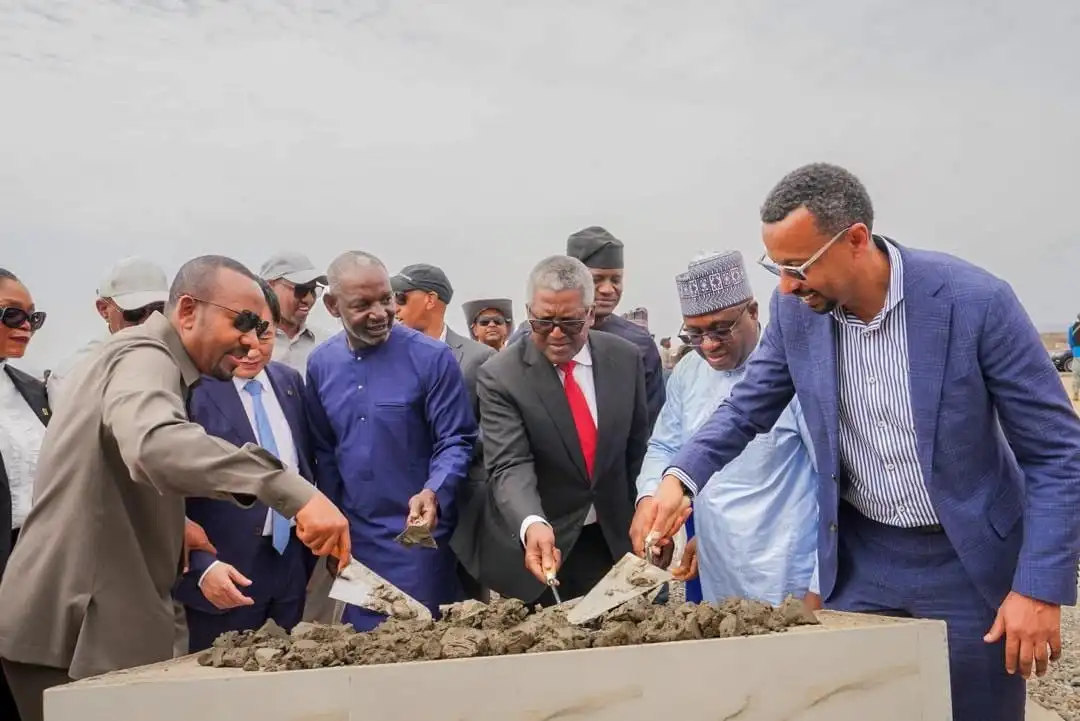
ADDIS ABABA — Aliko Dangote has sealed his most consequential East African industrial commitment to date.
In March 2026, Dangote Industries finalised a USD 4.2 billion, 25-year agreement with China's GCL Group to develop natural gas fields in Ethiopia's Ogaden Basin, anchoring a 3-million-tonne annual fertiliser complex in Gode, Somali Regional State, that is scheduled to reach commercial operations by 2029. According to The Nation Nigeria's reporting of the deal, the agreement establishes a 25-year gas off-take arrangement whose upstream supply feeds a urea and NPK blending complex that, at full capacity, will produce more fertiliser annually than Ethiopia currently imports from all external sources combined.
The deal's structure is the clearest available evidence that Dangote is executing his proven backward integration playbook in East Africa with the same disciplined capital architecture that made the Dangote Refinery in Nigeria the most consequential single industrial investment in African private sector history.
The capital structure and what it reveals
The Gode fertiliser complex is structured with Dangote Group holding 60% equity and Ethiopian Investment Holdings, the sovereign investment vehicle of the Ethiopian government, holding 40%. That ownership structure is not incidental. It positions the project as a genuinely bilateral industrial investment whose domestic institutional ownership aligns Ethiopian government interests with the project's commercial success in ways that purely foreign-owned extraction arrangements have historically failed to produce, and whose precedent for the East African industrial investment model reflects the same recognition that Dangote articulated to Norges Bank's Nicolai Tangen in May 2026 when he described his investment philosophy as building productive systems that create the domestic supply whose existence reduces import dependence rather than simply capturing the extraction revenue whose accumulation outside the host economy perpetuates the import cycle the investment was supposed to break.
The USD 4.2 billion capital stack includes a dedicated 120-megawatt power station within the project's capital expenditure, addressing the energy infrastructure constraint that large-scale industrial investment in Ethiopia's interior regions has historically faced. The 110-kilometre pipeline connecting the Calub and Hilala gas fields in the Ogaden Basin to the Gode complex provides the upstream supply infrastructure whose construction converts stranded gas reserves into the industrial feedstock that fertiliser production requires at competitive cost.
The 25-year duration of the GCL Group gas off-take agreement is the financing structure's most commercially significant characteristic. A 25-year gas supply contract provides the revenue visibility and cash flow predictability that project finance lenders require to commit the long-tenor capital that a USD 4.2 billion complex demands, and whose availability the combination of Belt and Road Initiative financing and Gulf sovereign wealth capital provides in ways that the ESG financing frameworks applying to the East African Crude Oil Pipeline have complicated for that project's commercial banking syndication. According to The Nation Nigeria's reporting, the project secures alternative funding through the Belt and Road Initiative and Gulf capital, bypassing the ESG financing challenges that have slowed EACOP's banking relationships while maintaining the commercial viability that the gas off-take contract's 25-year duration anchors.
The pipeline network and Ethiopia's maritime access problem
Ethiopian Investment Holdings and Dangote Group have secured trilateral approval from Djibouti for a dual-phase cross-border pipeline network whose construction addresses Ethiopia's most acute infrastructure constraint: the USD 1.5 to USD 2 billion annually that Ethiopia spends in Djibouti port fees according to available estimates, a fiscal drain whose magnitude reflects the landlocked state's dependence on road trucking from Djibouti's port to Ethiopian distribution points at the logistics cost that road freight imposes on every tonne of imported fuel, food, and industrial input.
Phase 1 of the pipeline network imports refined fuel from the Port of Djibouti to Dawale in southeastern Ethiopia, shifting bulk fuel movement from heavy truck convoys whose operating cost, road damage, customs delay, and security requirement impose the per-tonne premium that pipeline transport eliminates at the volume that Ethiopia's import requirements justify. The logistics cost reduction that pipeline delivery produces at Ethiopia's fuel import scale is the most immediately measurable financial return whose realisation precedes the fertiliser complex's 2029 commercial operation and provides the infrastructure foundation that Phase 2's hydrocarbon export direction requires.
Phase 2 exports crude and gas from the Ogaden Basin through the pipeline corridor to Djibouti's port for global market access, converting the Ogaden Basin's resource endowment from a stranded asset whose geographic remoteness from export infrastructure has historically prevented commercial development into the export revenue source whose generation changes Ethiopia's foreign exchange position at a scale whose magnitude the fertiliser complex's import substitution adds to rather than substitutes for.
The Djibouti approval's geopolitical significance extends beyond the commercial logistics it enables. Prime Minister Abiy Ahmed's pursuit of maritime access has generated regional tension whose diplomatic management the pipeline's private cross-border infrastructure model addresses by deepening Ethiopia-Djibouti economic integration through commercial investment rather than the sovereign territorial claims whose pursuit has historically been the source of the regional friction that the pipeline approach bypasses.
The Dangote playbook and why Ethiopia is the right market for it
Dangote's backward integration model has one consistent logic whose application across Nigeria's cement, fertiliser, and petroleum sectors has produced the industrial outcomes that make him Africa's wealthiest industrialist: identify the imported commodity whose domestic production would reduce the import bill, secure the natural resource feedstock whose domestic availability makes the production economics viable, build the processing infrastructure whose output substitutes for the import at delivered cost competitive with the import alternative, and scale to the regional export market whose size makes the investment commercially sustainable beyond the domestic demand base alone.
At the Dangote Urea Plant in Lekki, Nigeria, that playbook produced a facility that scaled to supply 65% of Nigeria's domestic fertiliser needs, transforming Nigeria from a fertiliser importer whose foreign exchange drain the plant's output replaced into a fertiliser producer whose regional export potential Dangote described to Norges Bank's Tangen as a market currently oversold at USD 850 per tonne. The same playbook applied to Ethiopia's Ogaden Basin gas and Gode fertiliser complex produces the same transformation at a market whose fertiliser import dependence is structurally deeper than Nigeria's was at the equivalent stage.
Ethiopia imported 2.32 million tonnes of fertiliser in 2024 according to Ethiopian agricultural import data, a volume whose foreign exchange cost at prevailing urea prices represents a significant drain on the country's reserve position and a constraint on the agricultural productivity of the smallholder farming system whose fertiliser access determines the food security of a population of over 120 million people. A Gode complex producing 3 million tonnes annually covers Ethiopia's entire import requirement and generates the regional export surplus whose sale to Kenya, Tanzania, Uganda, and Rwanda addresses the East African fertiliser supply deficit that all four economies experience at the import pricing that global urea markets impose.
Ethiopia receives 9% of Dangote's total planned global investment according to the project documentation, making it the group's largest single country focus outside Nigeria. That allocation is not sentimental. It reflects Dangote's commercial assessment that Ethiopia's combination of natural gas feedstock, large domestic agricultural market, regional export opportunity, and Ethiopian Investment Holdings' institutional partnership creates the investment case whose risk-adjusted return justifies the capital deployment at the scale that the USD 4.2 billion commitment represents.
What the 120-megawatt power station means for the Somali Regional State
The dedicated 120-megawatt power station included within the Gode complex's USD 4 billion capital expenditure is the industrial infrastructure investment whose significance extends beyond the fertiliser complex's own energy requirements into the regional development impact that captive industrial power generation produces in geographic areas whose grid connectivity limitations have historically constrained economic activity.
Gode, in Ethiopia's Somali Regional State, is a geography whose economic development has been constrained by the combination of infrastructure remoteness, historical conflict, and the absence of the reliable industrial energy supply that manufacturing and processing investment requires before it can be commercially rational. A 120-megawatt power station whose primary purpose is fertiliser complex operation but whose excess capacity creates the energy infrastructure that adjacent industrial and commercial activity can access changes the economic geography of the Somali Regional State in ways that grid extension alone, at the cost and timeline that remote area electrification requires, would not produce at equivalent pace.
The power station's presence alongside the gas pipeline, the fertiliser complex, and the Djibouti export corridor creates the industrial cluster whose agglomeration economics, the cost reduction and productivity improvement that proximate industrial activity generates for adjacent businesses, makes Gode a commercially rational location for the agricultural processing, logistics, and services investment whose attraction the fertiliser complex's raw industrial infrastructure alone does not generate.
The East African agricultural and industrial implications
The Gode fertiliser complex's 3-million-tonne annual output at 2029 commercial operation represents a structural change in East African agricultural input economics whose downstream implications for Tanzania, Kenya, Uganda, and Rwanda extend beyond Ethiopia's domestic agricultural productivity into the regional fertiliser market whose pricing the Gode complex's supply addition will influence at the scale that 3 million tonnes of annual output represents against the current regional import volumes.
Tanzania's agricultural sector, whose fertiliser import costs have constrained the smallholder productivity improvement that Vision 2050's food security ambitions require, benefits from a regional supply addition whose proximity and delivery logistics through East African trade corridors produce the delivered price reduction that distant global suppliers cannot match. President Samia's invitation to Dangote to invest in fertiliser production in Tanzania, confirmed at the 16 May 2026 State House meeting whose official statement Uchumi360 reported, reflects the recognition that Tanzania's domestic demand for fertiliser products remains significantly higher than current production capacity, and whose resolution the regional supply architecture that the Gode complex anchors begins to address even before a Tanzania-specific Dangote fertiliser investment reaches operational status.
Kenya's agricultural export sector, whose horticultural and flower export competitiveness depends on the input cost structure that fertiliser pricing significantly determines, benefits from the regional supply addition whose East African corridor delivery economics compare favourably against the Middle Eastern and European import alternatives whose shipping cost and transit time the Gode complex's overland East African distribution eliminates. Uganda's and Rwanda's smallholder farming systems, whose productivity improvement is the most direct available mechanism for reducing food insecurity in both economies, benefit from the fertiliser access improvement whose regional supply addition makes possible at the delivered prices that East African production economics produce.
What comes next and why regional investors should watch Gode
Commercial operations are scheduled for 2029, a timeline whose achievement requires the 110-kilometre gas pipeline construction from Calub and Hilala to Gode, the fertiliser complex's engineering, procurement, and construction phase, the power station's commissioning, and the Djibouti pipeline corridor's Phase 1 completion, all progressing simultaneously against the capital deployment schedule that the USD 4.2 billion commitment funds and the 25-year GCL Group gas off-take agreement provides the revenue visibility to support.
Regional investors tracking the downstream opportunities that the Gode complex creates should focus on three specific sectors whose commercial dynamics the 2029 commissioning will change most directly. Agricultural input distribution whose regional supply chain the complex's output will require at the scale that 3 million tonnes of annual fertiliser distribution across East African agricultural markets demands. Cold chain and logistics infrastructure whose development along the Ethiopia-Kenya-Tanzania-Rwanda distribution corridor the fertiliser supply chain creates as the physical distribution network. And agricultural processing investment whose commercial case the improved fertiliser access strengthens by making the smallholder productivity improvement that raises raw agricultural output commercially rational for the processing investment that converts that output into the higher-value products whose export economics justify the processing infrastructure.
Dangote built Africa's most consequential industrial complex in Nigeria by applying the backward integration logic whose consistency across every sector he has entered makes the Ethiopia investment's outcome more predictable than a first-country entry would suggest. The Gode fertiliser complex is not an experiment. It is the East African chapter of a proven industrial model whose Nigerian proof of concept is already exporting to Tanzania and the region. The chapter opens in 2029. The preparation for its consequences begins now.
FAQ
What did Dangote finalise in Ethiopia in March 2026? Dangote Industries finalised a USD 4.2 billion, 25-year agreement with China's GCL Group to develop natural gas fields in Ethiopia's Ogaden Basin, specifically the Calub and Hilala fields, through a 110-kilometre pipeline feeding a 3-million-tonne annual urea and NPK fertiliser complex in Gode, Somali Regional State. Ethiopian Investment Holdings holds 40% equity alongside Dangote Group's 60%. A dedicated 120-megawatt power station is included in the capital expenditure. Commercial operations are scheduled for 2029.
What is the Djibouti pipeline and why does it matter for Ethiopia? Dangote and Ethiopian Investment Holdings have secured trilateral approval from Djibouti for a dual-phase cross-border pipeline. Phase 1 imports refined fuel from Djibouti's port to Dawale in southeastern Ethiopia, eliminating the trucking cost that road freight currently imposes on Ethiopia's fuel imports. Phase 2 exports crude and gas from the Ogaden Basin through Djibouti to global markets. Ethiopia spends an estimated USD 1.5 to USD 2 billion annually in Djibouti port fees according to available estimates. The pipeline directly reduces that fiscal drain while simultaneously creating the export revenue channel that the Ogaden Basin's gas resources have historically lacked the infrastructure to access.
How does this replicate Dangote's Nigerian fertiliser model? The Dangote Urea Plant in Lekki scaled to supply 65% of Nigeria's domestic fertiliser needs, transforming Nigeria from a fertiliser importer into a regional exporter currently selling at USD 850 per tonne. The Gode complex applies the same backward integration logic: secure the natural gas feedstock from the Ogaden Basin, build the processing infrastructure in Gode, produce the urea and NPK fertiliser whose output substitutes for Ethiopia's 2.32 million tonne annual import, and scale to the regional East African export market whose size makes the investment commercially sustainable beyond domestic demand alone.
What does the deal mean for Tanzania and East Africa's agricultural economics? A 3-million-tonne annual fertiliser output from Gode by 2029 represents a structural change in East African agricultural input economics. Tanzania, Kenya, Uganda, and Rwanda all import fertiliser at global market prices whose East African delivered cost the Gode complex's regional supply addition will reduce through proximity and overland corridor logistics. President Samia's 16 May 2026 invitation to Dangote to invest in fertiliser production in Tanzania, confirmed in the official State House statement, reflects Tanzania's domestic demand gap whose regional supply architecture the Gode complex begins to address even before a Tanzania-specific investment reaches operational status.
Why does Ethiopia receive 9% of Dangote's total planned global investment? Because Ethiopia's combination of natural gas feedstock in the Ogaden Basin, a domestic agricultural market of over 120 million people whose fertiliser import dependence creates the largest single demand base for the Gode complex's output, the regional export opportunity across East Africa's collective fertiliser import bill, and Ethiopian Investment Holdings' 40% institutional partnership creates the investment case whose risk-adjusted return justifies the capital allocation that 9% of Dangote's global investment programme represents. Ethiopia is Dangote's largest single country focus outside Nigeria by investment volume, a commercial assessment rather than a geopolitical alignment.
How is the project financed and why does it avoid the EACOP's challenges? The project secures financing through the Belt and Road Initiative and Gulf capital, bypassing the ESG financing challenges that have complicated the East African Crude Oil Pipeline's commercial banking syndication. The UAE has invested USD 2.3 billion in Ethiopian infrastructure in recent years, and Dangote's strong credit profile and industrial execution track record provide Gulf sovereign wealth funds with a de-risked co-investment vehicle whose commercial credibility the 25-year GCL Group gas off-take agreement anchors at the revenue visibility level that project finance lenders require for long-tenor infrastructure commitments.
 Uchumi360
Business Intelligence
Uchumi360
Business Intelligence
- The Nation Nigeria, Dangote seals USD 4.2 billion gas deal with China's GCL Group, 2026
- USD 4.2 billion deal value, 25-year agreement, GCL Group partnership, Ogaden Basin development, Belt and Road Initiative and Gulf capital financing structure
- Available at thenationonlineng.net
- EcoFin Agency, Dangote deepens Ethiopia industrial expansion with USD 4 billion fertiliser project
- Gode fertiliser complex details, 60-40 equity split between Dangote Group and Ethiopian Investment Holdings, 3-million-tonne annual capacity, 120-megawatt power station
- Available at ecofinagency.com
- Ethiopian Investment Holdings, sovereign investment vehicle documentation and Gode complex equity participation
- Available at eih.gov.et
- Dangote Group, Aliko Dangote interview with Nicolai Tangen, CEO Norges Bank Investment Management, In Good Company podcast, May 2026
- Nigeria fertiliser pricing at USD 850 per tonne, backward integration model description, Ethiopia as largest investment outside Nigeria
- State House United Republic of Tanzania, official statement on Dangote-Samia meeting, 16 May 2026
- President Samia fertiliser investment invitation, Tanzania domestic demand exceeding production capacity
- Ethiopian Ministry of Agriculture, fertiliser import data
- 2.32 million tonnes imported in 2024
- Available at moa.gov.et
- Djibouti Port and Free Zone Authority, cross-border pipeline trilateral approval documentation
- Available at dpfza.gov.dj
- Dangote Industries, Lekki Urea Plant operational data
- 65% of Nigeria domestic fertiliser needs supply, regional export capacity
- Available at dangote.com
- UAE investment in Ethiopia documentation
- USD 2.3 billion in Ethiopian infrastructure in recent years
- Specific report requires identification before publication
- Rwanda Development Board, regional fertiliser import and agricultural input data
- Available at rdb.rw
- Uganda Bureau of Statistics, agricultural input and fertiliser import data
- Available at ubos.org
- Kenya National Bureau of Statistics, fertiliser import and horticultural export data
- Available at knbs.or.ke
- National Bureau of Statistics Tanzania, agricultural input and fertiliser import data
- Available at nbs.go.tz
- DRC Institut National de la Statistique, agricultural input data
- Available at ins-rdc.org
- African Development Bank, East Africa fertiliser supply and agricultural productivity research
- Available at afdb.org
- UNCTAD, East African agricultural trade and input economics data
- Available at unctad.org
Uchumi360 covers business, investment, and economic policy across East, Central, and Southern Africa.
For the serious reader
You read to the end. That places you in a small group.
Uchumi360 is built for readers who demand precision over speed, structure over sentiment, and analysis that holds uncomfortable conclusions rather than softening them. If this work sharpens how you think about Africa's economy, help us keep building the infrastructure behind it.
Institutional Partners
Commission intelligence. Shape the conversation.
Uchumi360 works with development finance institutions, investment firms, sovereign bodies, and strategic organisations across the coverage region. Institutional partnership unlocks:
- Commissioned sector and country intelligence reports
- Branded research series under your institution's authority
- Exclusive data briefings for internal strategy teams
- Speaking and editorial presence at Uchumi360 events
- Co-published investment outlooks for your markets
Support Our Work
Independent analysis has a cost. Help us bear it.
Uchumi360 does not carry advertising. It does not take editorial direction from sponsors. Every article is produced without commercial compromise. Your contribution funds the reporting, research, and editorial infrastructure that keeps this analysis free from influence.
Secure checkout: One-time and monthly support are processed securely. Add payment credentials to enable checkout here.
Stay Connected
Keep up with every new insight.
Follow our latest analysis, policy coverage, and market intelligence as soon as it is published. If you need something specific, reach out directly and we will point you to the right research.
