
Ethiopia Breaks Ground On its First Oil Refinery, Backed By China
Ready
Ethiopia broke ground on the Gode Oil Refinery, its first domestic refinery, in October 2025, a $2.5 billion, 3.5 million tonne (70,000 bpd) facility built by China's Golden Concord Group (GCL) alongside Ethiopian Investment Holdings, processing crude and condensate from the Hilala oil field in the Ogaden Basin. The refinery is co-located with a separate $2.5 billion, 3 million tonne urea fertiliser plant, a 60:40 joint venture between Dangote Industries and Ethiopian Investment Holdings, fed by gas from the Calub field via a 108km pipeline. In March 2026, Dangote and GCL signed a $4.2 billion, 25-year gas supply agreement to lock in that feedstock through 2029 completion. Ethiopia currently spends roughly $5 billion annually importing refined fuel; officials value the combined Somali Region industrial cluster, including the earlier Ogaden LNG project, at $10 billion.
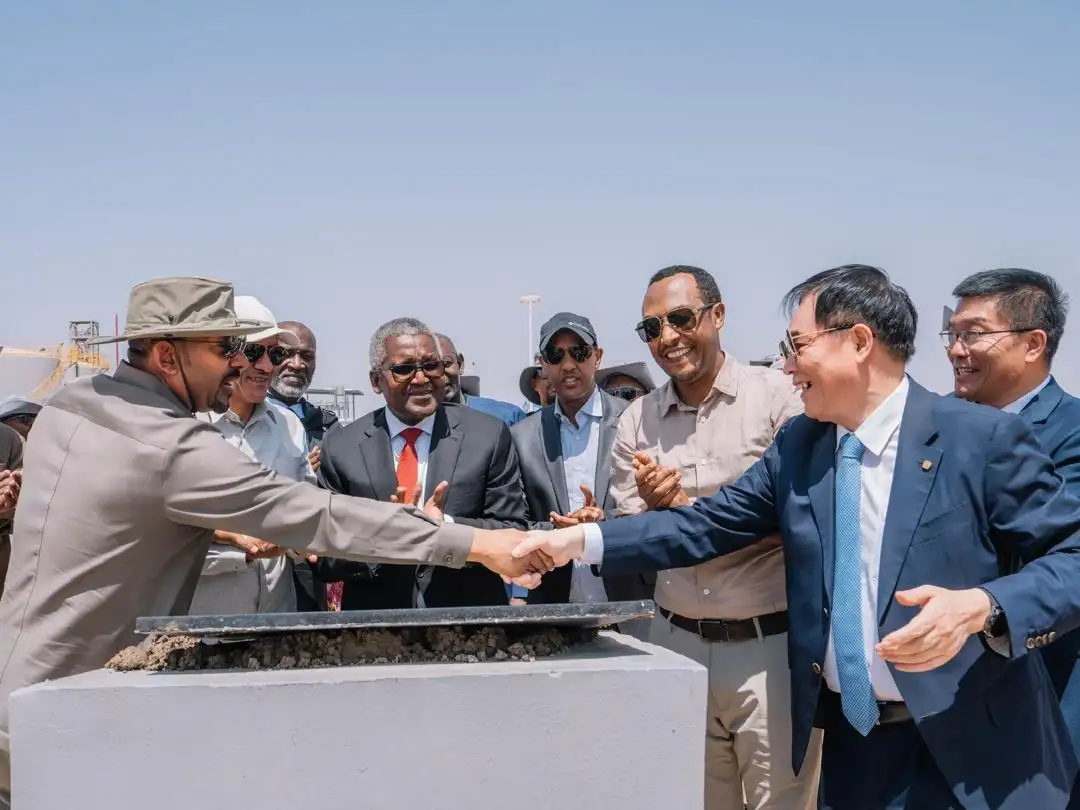
Ethiopia has never had a domestic oil refinery. That changed in October 2025, when Prime Minister Abiy Ahmed laid the foundation stone for the Gode Oil Refinery in Ethiopia's Somali Regional State, alongside a separate multi-billion-dollar urea fertiliser plant, in what he described as "a historic occasion for all Ethiopians."
What's being built
The Gode Oil Refinery is a $2.5 billion facility developed by China's Golden Concord Group Limited (GCL) in partnership with Ethiopian Investment Holdings (EIH), Ethiopia's state investment arm. It's designed to process 3.5 million tonnes of crude oil annually, roughly 70,000 barrels per day, sourced from the Hilala oil field in the Ogaden Basin. Once operational, it will produce diesel, petrol, jet fuel and liquefied petroleum gas domestically for the first time in Ethiopia's history. Construction is proceeding in two phases, with the first targeted for completion within 24 months of groundbreaking, putting initial output around late 2027.
Energy analysts estimate the refinery could meet roughly 70% of Ethiopia's current fuel needs once fully operational, a meaningful dent in a country that currently spends approximately $5 billion a year importing refined petroleum products.
A second, separate megaproject sits right next to it
Alongside the refinery, Abiy laid the foundation stone for a $2.5 billion urea fertiliser plant, a distinct project from the refinery but co-located in Gode and sharing the same regional gas infrastructure. The fertiliser plant is structured as a 60:40 joint venture, Dangote Industries holding 60%, Ethiopian Investment Holdings 40%, and is designed to produce 3 million tonnes of urea annually, positioning it as one of the world's largest single-site urea complexes. It draws its feedstock from the Calub gas field, delivered via a dedicated 108-kilometre pipeline, and is targeting completion by 2029.
The gas deal that locked in the fertiliser plant's supply
Five months after groundbreaking, in March 2026, Dangote Industries and GCL formalised a $4.2 billion, 25-year natural gas supply agreement in Lagos, guaranteeing GCL will deliver stable gas from Calub to the fertiliser complex for the plant's entire operating horizon. Aliko Dangote framed the deal as part of a broader industrial philosophy: "Africa's energy industry cannot continue indefinitely exporting raw materials while importing finished products. We must pursue a new path of highly autonomous development." GCL Chairman Zhu Gongshan credited the Ethiopian government's support for making the agreement possible.
That 25-year lock-in matters mechanically as much as symbolically. Fertiliser economics are unusually exposed to gas price volatility, natural gas typically accounts for 60-80% of total urea production costs, so a fixed-term, fixed-source supply agreement removes one of the biggest risk variables in the entire project's business case before construction is even finished.
GCL's deeper history in the Ogaden Basin
GCL isn't a new entrant to this region. The company first entered Ethiopia in 2013, taking over exploration concessions at Calub and Hilala, and briefly oversaw limited crude output from the Somali region in 2018, though exports never took off commercially at the time. The Gode refinery is the first major downstream facility to actually break ground in the basin, turning more than a decade of upstream exploration into an active industrial project. The basin itself has a long exploration history, natural oil seeps in the area were documented as early as 1860.
Just before the Gode groundbreaking, GCL also inaugurated the first phase of its Ogaden LNG project at Calub, an initial capacity of 111 million litres annually, with a planned second phase targeting 1.33 billion litres and 1,000 megawatts of electricity generation. Officials value the combined mega-projects across the Somali Region, refinery, fertiliser plant, LNG facility and associated infrastructure, at roughly $10 billion in total.
What Ethiopia is actually trying to solve
The strategic logic connecting these projects is straightforward: Ethiopia currently imports essentially all of its refined fuel and fertiliser, a direct and recurring drain on foreign currency reserves the government wants to close. Beyond meeting domestic demand, officials have said the refinery and fertiliser complex are positioned to eventually export surplus product to neighbouring markets, Somalia, Djibouti and Kenya, once Ethiopian domestic needs are secured, turning the Somali Region from Ethiopia's least industrialised area into a genuine regional supply hub for both fuel and fertiliser.
The Uchumi360 insight
Ethiopia has spent over a decade sitting on Ogaden Basin reserves without turning them into a functioning industrial base. Gode is the first real test of whether that changes. Pairing a Chinese-built refinery with a Nigerian-financed fertiliser complex, both drawing feedstock from the same basin, gives Ethiopia two separate downstream industries anchored to the same upstream gas and crude infrastructure at once, a more capital-efficient sequencing than building either in isolation. Whether the region actually becomes the energy and fertiliser hub officials are describing depends less on this groundbreaking than on whether the first 24-month phase hits its target and whether the gas actually flows on schedule for the next 25 years.
FAQ
What is the Gode Oil Refinery? Ethiopia's first domestic oil refinery, a $2.5 billion, 3.5 million tonne (70,000 bpd) facility being built by China's Golden Concord Group with Ethiopian Investment Holdings, processing crude from the Hilala oil field.
Is the fertiliser plant the same project as the refinery? No. It's a separate $2.5 billion facility, a 60:40 joint venture between Dangote Industries and Ethiopian Investment Holdings, though it's co-located in Gode and shares the region's gas infrastructure.
What is the $4.2 billion deal between Dangote and GCL? A 25-year natural gas supply agreement, signed in March 2026, guaranteeing GCL delivers gas from the Calub field to Dangote's fertiliser plant for its full operating life.
When will these projects be completed? The refinery's first phase is targeted for roughly 24 months after the October 2025 groundbreaking, late 2027. The fertiliser plant is targeting 2029.
How much does Ethiopia currently spend on fuel imports? Approximately $5 billion annually, the primary cost these projects are designed to reduce.
 Uchumi360
Business Intelligence
Uchumi360
Business Intelligence
- Sources: ENA (Ethiopian News Agency)
- allAfrica
- Rigzone
- S&P Global
- Energy Capital & Power
- Addis Standard
- Ecofin Agency
- Vanguard Nigeria
- Zawya
Uchumi360 covers business, investment, and economic policy across East, Central, and Southern Africa.
For the serious reader
You read to the end. That places you in a small group.
Uchumi360 is built for readers who demand precision over speed, structure over sentiment, and analysis that holds uncomfortable conclusions rather than softening them. If this work sharpens how you think about Africa's economy, help us keep building the infrastructure behind it.
Institutional Partners
Commission intelligence. Shape the conversation.
Uchumi360 works with development finance institutions, investment firms, sovereign bodies, and strategic organisations across the coverage region. Institutional partnership unlocks:
- Commissioned sector and country intelligence reports
- Branded research series under your institution's authority
- Exclusive data briefings for internal strategy teams
- Speaking and editorial presence at Uchumi360 events
- Co-published investment outlooks for your markets
Support Our Work
Independent analysis has a cost. Help us bear it.
Uchumi360 does not carry advertising. It does not take editorial direction from sponsors. Every article is produced without commercial compromise. Your contribution funds the reporting, research, and editorial infrastructure that keeps this analysis free from influence.
Secure checkout: One-time and monthly support are processed securely. Add payment credentials to enable checkout here.
Stay Connected
Keep up with every new insight.
Follow our latest analysis, policy coverage, and market intelligence as soon as it is published. If you need something specific, reach out directly and we will point you to the right research.
