
Uganda Reinstates Yapi Merkezi for $3 Billion SGR as Kenya Pushes Railway Towards Malaba
Ready
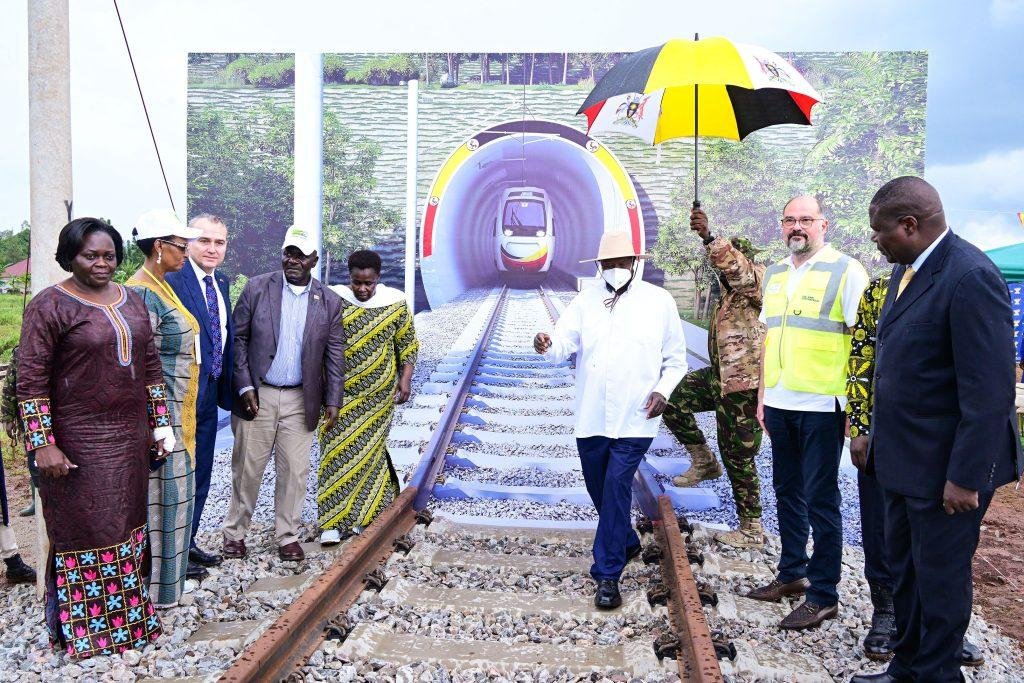
President Yoweri Museveni has directed Turkish contractor Yapi Merkezi to proceed with Uganda's 273 kilometre Standard Gauge Railway between Malaba and Kampala, reversing an earlier public declaration that the company had been removed. The decision comes as Uganda seeks to close a multibillion dollar financing gap while Kenya advances its railway extension towards the shared border, a connection both countries expect to substantially reduce the cost of moving cargo from Mombasa to Kampala.
Uganda has reaffirmed Turkish construction company Yapi Merkezi as the contractor for its €2.7 billion ($3 billion) Standard Gauge Railway (SGR) connecting Malaba on the Kenyan border to Kampala, following months of uncertainty over the company's future involvement in one of the country's largest infrastructure investments. The decision, communicated on November 6, 2026, by Chief of Defence Forces General Muhoozi Kainerugaba on the instructions of President Yoweri Museveni, restores political backing for the contractor as the government seeks to secure outstanding financing and advance construction preparations.
Kainerugaba announced that Yapi Merkezi had been approved to implement the first phase of the railway and instructed government departments to expedite the project. His statement reversed a June 16 declaration in which he had claimed that Uganda had cancelled the company's contract and would seek another contractor. However, the Ministry of Works and Transport had not publicly confirmed a formal contractual termination, making the November announcement a reversal of the earlier public position rather than independently established evidence of a newly executed construction agreement.
The railway project was awarded to Yapi Merkezi in October 2024, after Uganda abandoned an earlier agreement with China Harbour Engineering Company when financing negotiations failed. President Museveni formally launched the project in Tororo in November 2024, with the intention of constructing an electrified railway capable of transporting passengers and heavy freight between Kampala and the Kenyan border.
The latest decision comes at a critical stage for East African railway development. Kenya resumed construction of its Naivasha to Kisumu to Malaba railway extension in 2026, seeking to complete the missing western section of a network intended to connect Uganda directly with the Port of Mombasa. Kenya's existing SGR reaches Naivasha, but trains cannot yet travel continuously on standard gauge tracks from Mombasa to Uganda. The commercial value of the proposed regional railway therefore depends on both governments completing their respective sections and establishing compatible cross border operations.
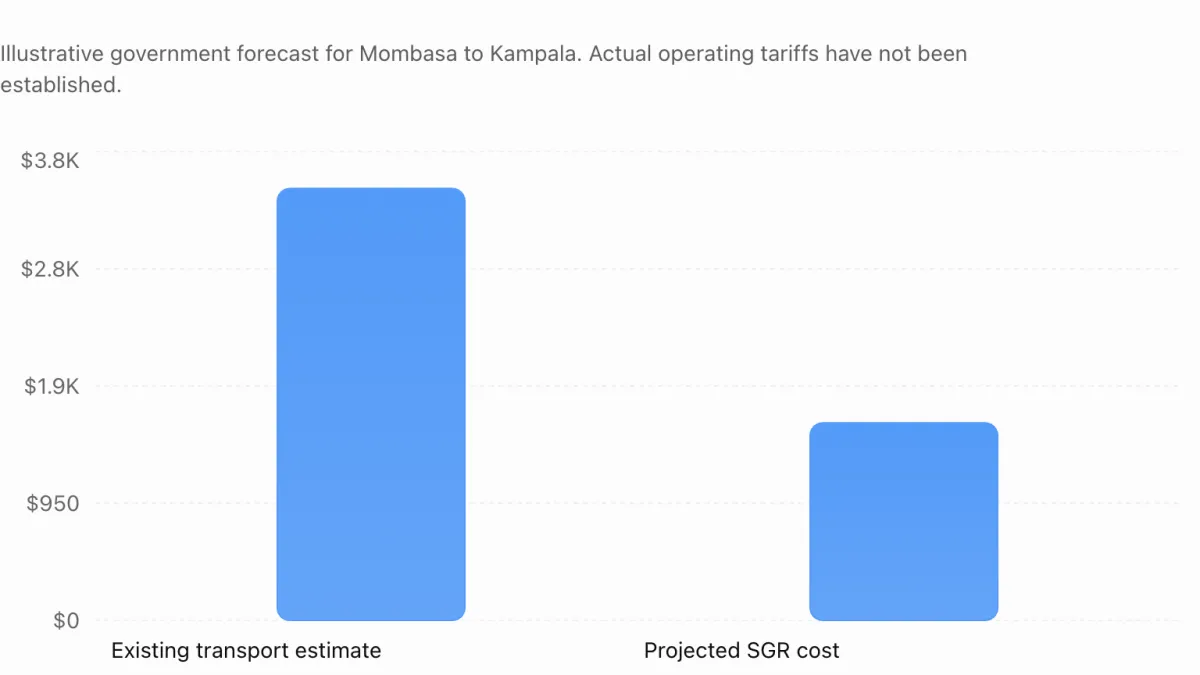
For Uganda, the investment is intended to reduce the high cost of transporting imported fuel, machinery, manufactured goods and other merchandise from the Kenyan coast while improving access to export markets for agricultural commodities and industrial products. The government has projected that moving a container from Mombasa to Kampala could eventually cost approximately $1,600 by rail, compared with an estimated $3,500 under existing transport arrangements, although those figures remain project forecasts rather than independently demonstrated operating savings.
A $3 Billion Railway Still Faces a Financing Challenge
Uganda signed its engineering, procurement and construction contract with Yapi Merkezi on October 14, 2024, with the government announcing a cost of approximately €2.7 billion, equivalent to UGX 10.8 trillion at the exchange rates used in its original announcement. The project covers roughly 273 kilometres of railway from Malaba through Tororo, Iganga and Jinja to Kampala, together with railway stations, maintenance facilities, bridges and associated infrastructure.
The proposed railway is designed as an electrified standard gauge system capable of handling substantial freight volumes, with planned connections to industrial facilities and logistics terminals along the route.
Under the project's financing framework, approximately 60% of construction costs are expected to be financed through export credit agencies, 25% through development finance institutions and 15% through Uganda's own resources.
This structure places considerable importance on securing international financing commitments before full construction proceeds. Export credit agency financing would support equipment and construction procurement, while development institutions are expected to finance major infrastructure components and associated works.
The government secured an important commitment on June 19, 2026, when the Islamic Development Bank approved €650.75 million for the railway. According to Uganda's Ministry of Finance, the financing is intended to support construction of a 553 metre bridge across the River Nile at Jinja, a 2.12 kilometre tunnel between Mbuya and Kampala, six railway stations and three maintenance workshops.
Additional financing remains under negotiation. In October 2026, the OPEC Fund for International Development began appraising a proposed €150 million facility, with its board expected to consider the project by November 30. Approval would increase Uganda's development finance commitments, but the loan had not reached final approval at the time of the November 6 announcement.
The government's financing schedule has also shifted. In June, Uganda's Ministry of Finance indicated that financial closure was expected by November 2026. Subsequent project updates moved the target to January 2027, reflecting the additional time needed to conclude financing arrangements.
These dates matter because the project's 48-month implementation period is intended to run from effective commencement, rather than simply from the original groundbreaking ceremony in 2024. Assuming financial close is achieved in early 2027 and construction proceeds without major interruptions, the full implementation period would extend into 2031.
The government has not yet established that every source of financing has been secured or that the full construction programme has entered its contractual implementation period.
Construction Preparations Advance as Uganda Works to Acquire Remaining Land
Although the government launched the project in November 2024, construction activity has remained concentrated on preparatory works rather than full railway construction across the entire corridor.
Under a €75 million Limited Notice to Proceed, Uganda authorised Yapi Merkezi to undertake preliminary activities before the main financing arrangements were completed. These included establishing a railway sleeper manufacturing facility, concrete batching plant, materials testing laboratory and workers' accommodation at the contractor's construction camp in Iganga.
According to project updates issued in October 2026, these facilities were largely complete, enabling the contractor to prepare for a wider construction programme once financing and land acquisition requirements were satisfied. Geotechnical investigations and engineering preparations had also advanced.
Land acquisition remains another substantial requirement. The project reported that approximately 70% of the necessary land had been acquired by October, with outstanding compensation and acquisition activities concentrated in parts of Mukono, Wakiso and Kampala.
Acquiring railway land can be especially difficult in densely populated urban areas, where construction may affect residential properties, commercial buildings, utility connections and existing roads. The Kampala section also includes a planned tunnel, introducing additional engineering and environmental requirements.
The railway must cross the River Nile near Jinja, where a dedicated bridge will accommodate standard gauge trains. These structures contribute to the project's relatively high construction cost per kilometre compared with railway developments built across less technically demanding terrain.
The immediate effect of Museveni's November directive is therefore to remove uncertainty over the government's publicly stated support for the existing contractor. It does not automatically resolve outstanding financing commitments, compensation claims or construction requirements.
Kenya's Railway Extension Will Determine When Uganda Can Reach Mombasa by SGR
Uganda's investment is closely connected to Kenya's programme to extend its existing standard gauge railway westward from Naivasha.
Kenya commissioned the Mombasa to Nairobi section in 2017 and subsequently extended the railway to Naivasha. However, the intended continuation towards Kisumu and Malaba remained delayed for several years, preventing the new railway from providing a continuous standard gauge freight connection to Uganda.
That position began changing in March 2026 when President William Ruto launched construction of the Naivasha to Kisumu to Malaba extension. In July, Kenya Railways confirmed that contractors had commenced physical works on the Naivasha to Kisumu section, including initial rail and sleeper installation in Narok.
According to Kenya's Ministry of Roads and Transport, the project includes approximately 264 kilometres of mainline between Naivasha and Kisumu, an 8.69 kilometre branch to the proposed Kisumu Port and a further 107 kilometres between Kisumu and Malaba. The route crosses several counties, including Narok, Bomet, Nyamira, Kericho and Kisumu, before reaching the Kenyan border with Uganda.
The Kenyan government's reporting in October placed the estimated cost of the railway extension at approximately KSh 651 billion, up from earlier projections. The proposed financing involves substantial external borrowing, with the government expecting to support the project through arrangements linked to railway development revenues and other funding commitments.
The railway systems have been designed to connect at Malaba, creating the possibility of transferring freight directly between Kenya and Uganda without the change of track gauge currently required between modern standard gauge infrastructure and older metre gauge networks.
However, the two systems will not necessarily become operational simultaneously. Construction schedules, financing arrangements, signalling compatibility, railway traction systems, customs procedures and the availability of freight terminals will all influence when cross border services can begin.
Kenya's railway currently operates with diesel traction, while Uganda has chosen an electrified system. Different traction systems do not automatically prevent interoperability, but operators would need appropriate locomotives, locomotive changes or other technical arrangements to support uninterrupted freight movement.
The economic value of the connection will depend on achieving reliable services across both networks rather than completing individual national railway sections in isolation.
Uganda Expects Container Transport Costs to Fall by More Than Half
The proposed railway is intended to address a substantial transport cost faced by Uganda's importers and exporters. Uganda is landlocked and relies heavily on regional transport corridors for international trade. Mombasa provides a major maritime outlet, while road freight continues to carry a large share of cargo moving between the Kenyan coast and Uganda.
In its 2026/27 national budget speech, Uganda's Ministry of Finance projected that the completed SGR connection could reduce container transport costs from approximately $3,500 to $1,600 between Mombasa and Kampala. The government also projected that transit times could fall from five days to one day.
The projected savings would be commercially relevant for businesses importing machinery, construction materials, manufactured products and industrial inputs. Lower freight costs could also improve the competitiveness of Ugandan agricultural and manufactured exports, particularly where logistics account for a substantial share of the final delivered price.
However, the government projections require careful interpretation. Actual freight rates will depend on the railway operator's pricing model, cargo volumes, terminal charges, customs clearance costs, inland distribution and the financing and maintenance obligations of the new infrastructure.
A quoted railway transport cost may also exclude services that are included in an existing road freight quotation, such as collection from a warehouse or final delivery to a customer's premises. Comparing the two modes therefore requires consistent accounting for the complete movement of cargo.
The project must also attract enough traffic to support its operating costs and capital requirements. Freight volumes will be influenced by the willingness of shipping companies, importers, manufacturers and transport operators to shift cargo from road to rail.
For Uganda, the commercial viability of the railway will ultimately depend on whether lower transport costs can be delivered consistently while generating enough revenue to support railway operations and maintenance.
Yapi Merkezi's Role in Tanzania Adds a Regional Dimension
The decision to retain Yapi Merkezi in Uganda comes as the same Turkish construction company faces scrutiny over delays on Tanzania's Standard Gauge Railway.
In October 2026, Tanzania's Transport Minister Makame Mbarawa publicly criticised Yapi Merkezi over slow progress on the Makutupora to Tabora and Tabora to Isaka sections of the country's railway, despite the availability of financing. The Tanzania Railways Corporation has increased its involvement in construction materials and expenditure controls, while additional subcontractors have been engaged to accelerate work.
The Ugandan and Tanzanian projects are governed by separate contracts, involve different government clients and have distinct financing arrangements. Problems reported on one project do not establish that the same problems exist on the other.
Nevertheless, the contractor's involvement in major railway investments in both countries creates a legitimate commercial question about project delivery capacity, particularly its ability to mobilise engineering personnel, specialised equipment, subcontractors and working capital across different construction programmes.
Uganda's railway is also entering its main implementation stage after an extended period of financing and land acquisition preparations. These constraints are not necessarily attributable to the contractor, but they increase the importance of clear milestones and an adequate financial structure before major construction begins.
Yapi Merkezi's earlier contract dispute in Uganda illustrates another source of risk: the uncertainty created when public statements about project cancellation are made without a corresponding publicly documented contractual decision.
For investors and lenders, certainty over the construction contractor, the enforceability of agreements and the responsibilities of the contracting government are essential to financing a major infrastructure project. Uganda's latest directive clarifies the president's position on the contractor, but the practical test will be whether the government can reach financial close and commence the main construction programme under the agreed conditions.
A Railway Connection That Could Extend Beyond Kampala
The Malaba to Kampala section forms part of Uganda's wider ambition to establish a modern railway network connecting the country to neighbouring markets.
The government has proposed subsequent railway extensions towards western Uganda, including Kasese and Mpondwe at the border with the Democratic Republic of Congo. Additional connections could eventually serve northern Uganda and South Sudan.
These developments would extend the potential market for the SGR beyond Uganda's domestic freight demand. Eastern DRC is an important market for imports of food, fuel, manufactured goods and construction materials, while western Uganda supports agricultural production, industrial activity and emerging petroleum developments.
President Museveni reiterated these ambitions in March 2026 during the launch of Kenya's railway extension towards Malaba. According to Uganda's Ministry of Works and Transport, he indicated that Uganda intended to extend the railway from Kampala towards Kasese and Mpondwe, with the eventual objective of connecting to the DRC.
Such extensions could strengthen the Northern Corridor's commercial position, but they would require separate financing, construction and agreements with neighbouring countries.
The success of those future investments will depend partly on the performance of the first section. A reliable Malaba to Kampala railway could provide evidence of demand and operating efficiency to support additional construction. Conversely, low freight volumes or persistent financial difficulties could weaken the case for expansion.
Uganda is also rehabilitating parts of its existing metre gauge railway, including the Tororo to Gulu corridor, to improve freight movement while the SGR is developed. The continued operation of older rail infrastructure may provide additional transport options, although differences in track gauge and equipment requirements create practical limitations on integration.
Financing and Cross Border Coordination Will Determine the Railway's Commercial Value
The November 6 decision provides political confirmation that Yapi Merkezi remains Uganda's preferred contractor for the first phase of the SGR. It follows two years of preparations, an Islamic Development Bank financing approval and negotiations with additional lenders.
The government's next milestones are more demanding. It must conclude outstanding financing agreements, complete the remaining land acquisition, move beyond preliminary construction activities and establish an implementation schedule consistent with the project's contractual obligations.
Kenya, meanwhile, must complete its own railway extension from Naivasha through Kisumu to Malaba. The two governments will then need to coordinate freight operations, tariffs, border procedures and railway services to create a commercially effective connection between Mombasa and Kampala.
The investment offers the prospect of substantially reducing the cost of moving freight along one of East Africa's most important trade routes. Yet those benefits remain dependent on completing expensive infrastructure in two countries, coordinating their railway operations and attracting sufficient cargo to sustain the resulting network.
Uganda's reaffirmation of Yapi Merkezi resolves the immediate political uncertainty over the contractor. The larger financing and construction requirements remain, and the government's ability to meet them will determine when the promised reductions in freight costs become available to Ugandan businesses.
 Uchumi360
Business Intelligence
Uchumi360 covers business, investment, and economic policy across East, Central, and Southern Africa.
For the serious reader
You read to the end. That places you in a small group.
Uchumi360 is built for readers who demand precision over speed, structure over sentiment, and analysis that holds uncomfortable conclusions rather than softening them. If this work sharpens how you think about Africa's economy, help us keep building the infrastructure behind it.
Institutional Partners
Commission intelligence. Shape the conversation.
Uchumi360 works with development finance institutions, investment firms, sovereign bodies, and strategic organisations across the coverage region. Institutional partnership unlocks:
- Commissioned sector and country intelligence reports
- Branded research series under your institution's authority
- Exclusive data briefings for internal strategy teams
- Speaking and editorial presence at Uchumi360 events
- Co-published investment outlooks for your markets
Support Our Work
Independent analysis has a cost. Help us bear it.
Uchumi360 does not carry advertising. It does not take editorial direction from sponsors. Every article is produced without commercial compromise. Your contribution funds the reporting, research, and editorial infrastructure that keeps this analysis free from influence.
Secure checkout: One-time and monthly support are processed securely. Add payment credentials to enable checkout here.
Stay Connected
Keep up with every new insight.
Follow our latest analysis, policy coverage, and market intelligence as soon as it is published. If you need something specific, reach out directly and we will point you to the right research.
