
917,167 Visitors, 78 Airlines and a $14.3 Billion Pipeline: Zanzibar’s Rise as the Indian Ocean’s Fastest-Scaling Tourism Economy
Ready
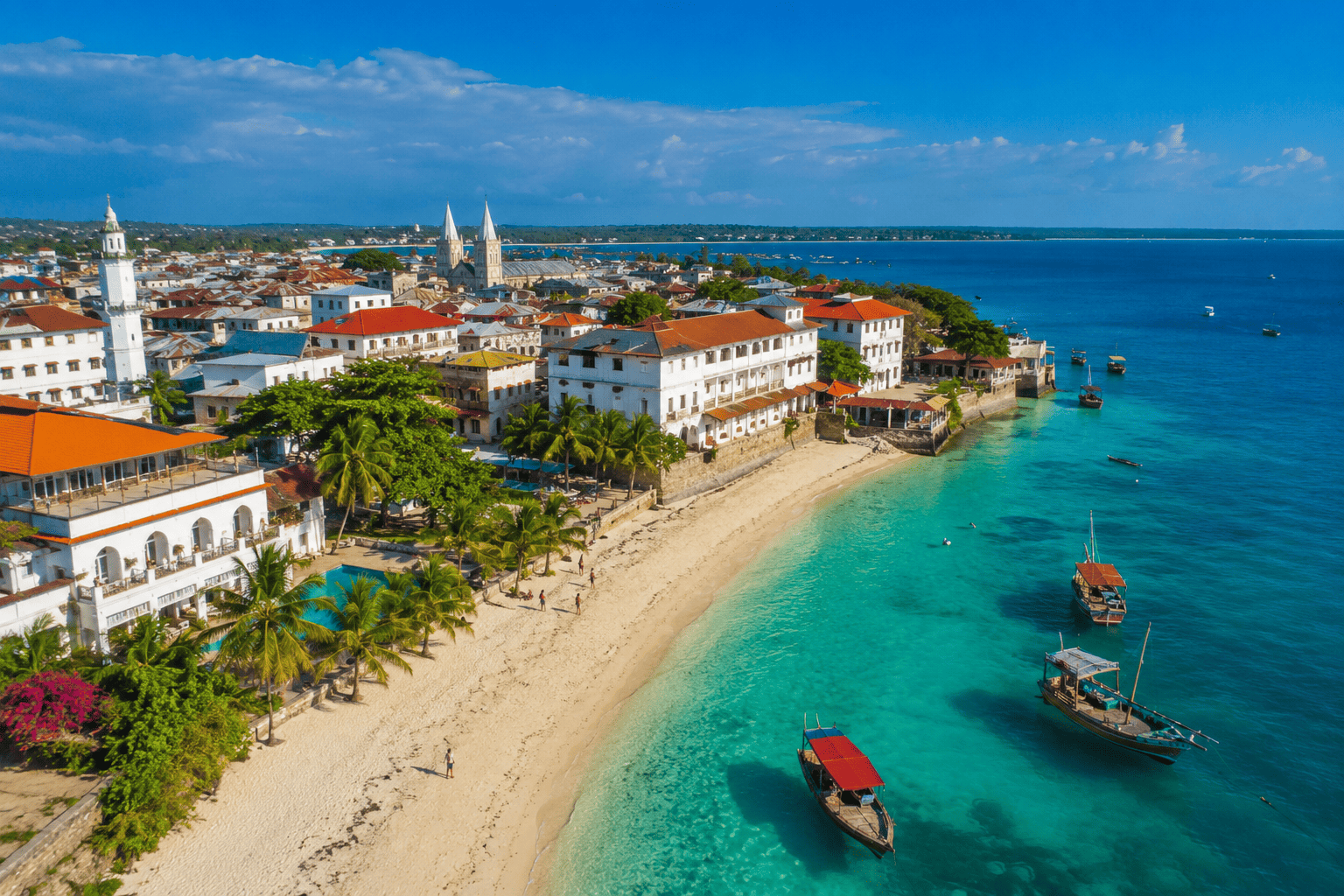
Zanzibar is no longer simply the beach extension to a Tanzanian safari. It is becoming one of the most important tourism growth stories in the Western Indian Ocean, and the numbers now place it in a different competitive category from where it was five years ago. The archipelago has already moved ahead of Seychelles, Madagascar and Comoros by annual visitor volume, while the comparison with Mauritius is becoming more interesting: Mauritius is still bigger in total arrivals, but Zanzibar is growing much faster, adding more incremental visitors, attracting heavy hospitality and real estate investment, and building the air-connectivity base that determines which island destinations scale and which ones remain boutique.
Zanzibar is no longer simply the beach extension to a Tanzanian safari. It is becoming one of the most important tourism growth stories in the Western Indian Ocean, and the numbers now place it in a different competitive category from where it was five years ago. The archipelago has already moved ahead of Seychelles, Madagascar and Comoros by annual visitor volume, while the comparison with Mauritius is becoming more interesting: Mauritius is still bigger in total arrivals, but Zanzibar is growing much faster, adding more incremental visitors, attracting heavy hospitality and real estate investment, and building the air-connectivity base that determines which island destinations scale and which ones remain boutique.
The clearest headline is arrivals. Zanzibar received 917,167 international visitors in 2025, up from 736,755 in 2024, a rise of about 24.5%. Mauritius, by comparison, received 1,436,250 tourists in 2025, up from 1,382,177 in 2024, a growth rate of 3.9%. In absolute terms, Zanzibar added roughly 180,400 visitors in one year, more than three times the additional visitors Mauritius added over the same period. The gap between the two narrowed from about 645,400 visitors in 2024 to about 519,100 visitors in 2025. Mauritius remains the bigger destination, but Zanzibar is the faster-moving one.
Against Seychelles, the shift is already visible. Seychelles closed 2025 with 398,841 visitor arrivals, up from 352,762 in 2024, a strong performance for a high-value island destination, but still less than half of Zanzibar’s 2025 total. Madagascar, despite being a much larger island economy with enormous ecological and cultural assets, recorded about 315,000 international visitors in 2024 and is targeting one million tourists by 2028. Comoros remains much smaller, with local tourism reporting citing 69,831 air arrivals in 2023/24. On pure arrival volume, Zanzibar has already moved into second place among these Western Indian Ocean island destinations, behind Mauritius but ahead of Seychelles, Madagascar and Comoros.
| Destination | Recent visitor arrivals | Growth signal |
| Mauritius | 1,436,250 in 2025 | +3.9% from 2024 |
| Zanzibar | 917,167 in 2025 | +24.5% from 2024 |
| Seychelles | 398,841 in 2025 | +13% from 2024 |
| Madagascar | About 315,000 in 2024 | Targeting 1 million by 2028 |
| Comoros | 69,831 air arrivals in 2023/24 | Small base, recovery stage |
The global context helps explain why Zanzibar’s acceleration matters. International tourism returned strongly after the pandemic, with UN Tourism estimating 1.4 billion international tourist arrivals globally in 2024, almost back to 2019 levels, and reporting that Africa was one of the strongest regions in early 2025, with arrivals up 9% year-on-year in the first quarter and 16% above pre-pandemic 2019 levels. That rising global tide is not lifting all islands equally. The winners are destinations with airlift, investable land, hotel capacity, policy clarity and a clear travel proposition.
Zanzibar’s advantage is that it is scaling across several layers at once. It has the beach product associated with the Indian Ocean, the cultural depth of Stone Town, the spice-island identity, the safari add-on from mainland Tanzania, and increasingly, a real estate and lifestyle-investment story that many rival islands either regulate more tightly or cannot expand as quickly. It is not as polished as Mauritius, not as exclusive as Seychelles, and not as ecologically vast as Madagascar. Its edge is that it is more scalable than all of them.
Aviation is the strongest infrastructure signal. Zanzibar Airports Authority data show passenger traffic rising from 840,599 in 2020 to 2.4 million in 2024, with projections expected to exceed 2.8 million in 2025. The number of airlines operating in Zanzibar rose from 68 in 2020 to 78 in 2024, while 38 airlines were expected to offer direct flights in 2025. Zanzibar’s airport was also reported to have ranked ninth in Africa for flight frequency in 2025.
That airlift story is not cosmetic. Island tourism is an aviation-led business. Mauritius built its tourism economy around reliable long-haul access, resort infrastructure and a stable investment climate. Seychelles built a high-value, lower-volume model around exclusivity and environmental control. Madagascar has enormous product depth, but air and road access continue to limit conversion. Madagascar’s own tourism authorities have discussed increasing weekly flight rotations from 60 to 105 as part of the push toward one million visitors by 2028, showing that air access remains one of the country’s key bottlenecks.
Zanzibar, by contrast, is rapidly turning into a direct-flight leisure platform. European and Middle Eastern carriers have made the island easier to sell as a standalone holiday, not only as an add-on to Serengeti or Ngorongoro. The result is a tourism economy that is becoming less dependent on the old “safari plus beach” formula and more capable of attracting resort tourists, digital nomads, destination weddings, wellness travellers, real estate buyers and regional conference traffic.
Investment data shows the same direction. ZIPA reports USD 14.29 billion in approved investment capital across 1,351 projects, while its investment platform says tourism has attracted more than 62% of approved investment projects. This is not the same as realised FDI, and it should not be presented as money already spent on the ground. But as an investment pipeline signal, it is significant. It shows that Zanzibar’s tourism boom is being matched by formal project approvals in hospitality, tourism recreation, islets, real estate and infrastructure.
Real estate is where Zanzibar’s tourism story begins to look structurally different from the older Indian Ocean destinations. Mauritius has long been known for resort-linked property schemes, but it is now a mature market. Seychelles has scarcity, but limited land and strict environmental controls. Madagascar has land and product diversity, but infrastructure and governance friction. Zanzibar is positioning itself as a more accessible lifestyle-property market, particularly around master-planned developments, serviced apartments, gated villas and mixed-use coastal projects.
Fumba Town is the clearest example of that shift. The development reports more than 1,700 homes sold, more than 1,000 homes delivered, over 2,500 residents, and buyers or residents from more than 70 nationalities. The numbers matter because they show Zanzibar is not only building hotels for tourists; it is building residential and investment communities around tourism demand. That is the bridge between hospitality FDI and real estate FDI.
Policy is supporting the direction. Zanzibar’s investor-service framework positions ZIPA as a one-stop centre for investment certificates, tax registration, company registration, business licences, land access, immigration services and export-processing-zone services. For hotels and real estate, the minimum investment capital requirement is listed at USD 2.5 million for foreign investors and USD 300,000 for local investors, which places the sector in a more formal, capital-intensive investment category.
The incentive environment is also explicit. The East African Community’s Zanzibar investment guide lists opportunities in tourism and hospitality, including MICE tourism, eco-tourism, halal tourism, sport tourism, marine tourism, cultural and heritage tourism, art and entertainment tourism and medical tourism. It also identifies real estate opportunities in commercial, residential and affordable housing. The same guide lists incentives including corporate tax exemptions, VAT and customs relief on capital goods, 100% foreign ownership, and 100% repatriation of profit after tax.
This is why Zanzibar’s tourism growth should be understood as a policy-led investment story, not simply a demand recovery. The government is not only marketing beaches. It is building a tourism-real estate-investment ecosystem around air access, land allocation, investor facilitation, island opportunities, blue economy positioning and special economic zones. ZIPA’s opportunity platform explicitly places tourism within the Blue Economy, which the government describes as a priority investment area connected to marine resources, coastal livelihoods, sustainable development and job creation.
Hotel brands are responding. Recent reports note several Zanzibar hospitality developments, including Egyptian hotel group Jaz opening Jaz Adonia, a 182-room resort in Uroa Bay, with Jaz Amaluna and Jaz Aurora following, the reopening of &Beyond Mnemba Island, and Marriott bringing its first Le Méridien property to Bwejuu. These are not isolated projects; they reflect a wider repositioning of Zanzibar from mid-market tropical escape to a layered destination with boutique luxury, branded resorts, serviced real estate and lifestyle investment.
The Mauritius comparison is still the most important. Mauritius has deeper institutional maturity, higher arrivals, a strong air-and-resort legacy, and a more developed luxury real estate market. But its growth is now incremental. Statistics Mauritius shows accommodation and food service activities expected to grow by 3.5% in 2025, based on expected arrivals of around 1.435 million, while private investment was expected to decline in 2025. That suggests a mature island economy managing growth rather than an emerging island economy absorbing a new wave of demand.
Zanzibar is still earlier in the curve. That comes with risk. Faster growth can strain water, waste, roads, energy, land governance, heritage preservation and local affordability. It can also create uneven benefits if beachfront land, hotels and property assets become dominated by foreign capital while local communities remain concentrated in low-wage work. These pressures are common in island economies, but they become more urgent when arrivals and real estate investment rise faster than public infrastructure.
That is where the comparison with Seychelles becomes useful. Seychelles has chosen a more constrained, higher-value model, with visitor arrivals below Zanzibar but a strong premium positioning and strict environmental identity. Zanzibar is choosing scale. The challenge is whether it can scale without diluting the island experience that made it attractive in the first place.
Madagascar shows the opposite lesson. It has extraordinary biodiversity, a large island geography and a strong ambition to reach one million tourists by 2028, but infrastructure gaps remain central. Reporting on Madagascar’s tourism strategy notes the need for 10,000 additional rooms, the construction of five five-star hotels, and the fact that only two airports currently handle long-haul flights, with ten other airports under study for modernisation. Zanzibar’s advantage is not that it has more natural diversity than Madagascar. It is that the conversion infrastructure between visitor desire and actual arrivals is working better.
Comoros, meanwhile, remains a reminder that beauty alone does not build a tourism economy. The archipelago has strong natural and cultural appeal, but its visitor base remains small, and the hotel-capacity agenda is still in an early stage, with local reporting citing plans to add 700 rooms to the existing 876 rooms ahead of the 2027 Indian Ocean Island Games. Zanzibar is already operating at a scale that Comoros is still trying to prepare for.
Zanzibar is not yet bigger than Mauritius, but it is becoming the fastest-scaling tourism economy among the Western Indian Ocean archipelagos. It has already overtaken Seychelles, Madagascar and Comoros on visitor volume, and it is narrowing the gap with Mauritius through faster arrivals growth, stronger airport momentum, visible hospitality investment, and a real estate market that is increasingly linked to tourism demand.
The deeper story is that Zanzibar is becoming less of a destination and more of a platform. It is a platform for leisure travel, safari extensions, branded hotels, beach real estate, blue economy investment, cultural tourism, marine recreation, second homes and regional aviation. That platform is still under construction, and its sustainability will depend on whether public infrastructure, local inclusion and environmental safeguards keep pace with private capital.
If Zanzibar gets that balance right, the island will not merely be catching up with the Indian Ocean’s established destinations. It will be changing the competitive map altogether.
 Uchumi360
Business Intelligence
Uchumi360
Business Intelligence
Uchumi360 covers business, investment, and economic policy across East, Central, and Southern Africa.
For the serious reader
You read to the end. That places you in a small group.
Uchumi360 is built for readers who demand precision over speed, structure over sentiment, and analysis that holds uncomfortable conclusions rather than softening them. If this work sharpens how you think about Africa's economy, help us keep building the infrastructure behind it.
Institutional Partners
Commission intelligence. Shape the conversation.
Uchumi360 works with development finance institutions, investment firms, sovereign bodies, and strategic organisations across the coverage region. Institutional partnership unlocks:
- Commissioned sector and country intelligence reports
- Branded research series under your institution's authority
- Exclusive data briefings for internal strategy teams
- Speaking and editorial presence at Uchumi360 events
- Co-published investment outlooks for your markets
Support Our Work
Independent analysis has a cost. Help us bear it.
Uchumi360 does not carry advertising. It does not take editorial direction from sponsors. Every article is produced without commercial compromise. Your contribution funds the reporting, research, and editorial infrastructure that keeps this analysis free from influence.
Secure checkout: One-time and monthly support are processed securely. Add payment credentials to enable checkout here.
Stay Connected
Keep up with every new insight.
Follow our latest analysis, policy coverage, and market intelligence as soon as it is published. If you need something specific, reach out directly and we will point you to the right research.
