
Spiro Raises USD 215 Million to Electrify Africa's Most Important Vehicle. The Bodaboda.
Ready
Spiro has raised USD 215 million in equity financing from institutional investors including Denmark's Impact Fund to expand its battery-swapping electric motorcycle network across Africa, building on a current operational footprint of 100,000 electric vehicles and 2,500 smart-swap stations across seven markets: Kenya, Rwanda, Uganda, Togo, Benin, Nigeria, and Cameroon. The new funding will support battery-swapping network expansion, local manufacturing and assembly strengthening, and market entry into the DRC and Ethiopia. Spiro operates manufacturing plants in Kenya, Rwanda, and Uganda and a battery recycling facility in Nigeria. Riders cut daily transport costs by up to 40%, saving as much as USD 2 per day versus gasoline motorcycles. The company is developing solar-powered battery-swapping stations and second-life battery storage systems. Spiro founder Gagan Gupta confirmed the next growth phase will focus on delivering transport alternatives to millions of riders across the continent. Denmark's Impact Fund CEO Lars Bo Bertram described the investment as reflecting confidence in Africa's electric mobility market. The article situates the raise within the African electric mobility market's development trajectory, identifies the battery-swap model's specific commercial advantage over the conventional EV charging model in African urban transport conditions, and identifies the East African manufacturing and recycling infrastructure whose development makes Spiro's model more than a mobility company. Africa's electric vehicle story is not about Tesla. It is about the bodaboda rider in Kampala, the delivery driver in Lagos, and the commuter in Kigali whose daily transport cost drops by 40% the moment they switch from petrol to Spiro's battery-swap network. USD 215 million says the model works. 100,000 electric vehicles on African roads says it is already working.
NAIROBI — African electric vehicle firm Spiro has raised USD 215 million in equity financing to expand its battery-swapping and electric mobility infrastructure across Africa, the company confirmed, in a round backed by institutional investors in Europe and Africa including Denmark's Impact Fund whose participation underscores the growing institutional confidence in Africa's clean transport sector as a commercially viable investment category rather than a development finance charity case.
The raise is the largest single equity financing round in African electric mobility history and the clearest available signal that the battery-swap model whose commercial logic Spiro has been validating across seven markets over the past several years has demonstrated the unit economics whose durability institutional investors from European impact finance require before committing capital at this scale.
What Spiro has built and where it operates
Spiro operates in seven markets across East and West Africa: Kenya, Rwanda, Uganda, Togo, Benin, Nigeria, and Cameroon. Across those seven markets, the company has deployed 100,000 electric vehicles and 2,500 smart-swap stations, creating the battery exchange infrastructure network whose geographic density is the enabling condition for the business model whose commercial proposition is fundamentally different from the conventional EV charging model that works in European and Chinese urban environments but whose four-hour charging time, grid reliability requirement, and upfront battery ownership cost make it commercially impractical for the African urban two-wheeler rider whose daily income depends on continuous vehicle availability.
"This past year marked a defining strategic milestone for Spiro," Gagan Gupta, founder of Spiro and chair of Equitane, said. "Across seven active markets, our deployment of 100,000 electric vehicles and 2,500 smart-swap stations has turned sustainable mobility into an affordable, everyday reality."
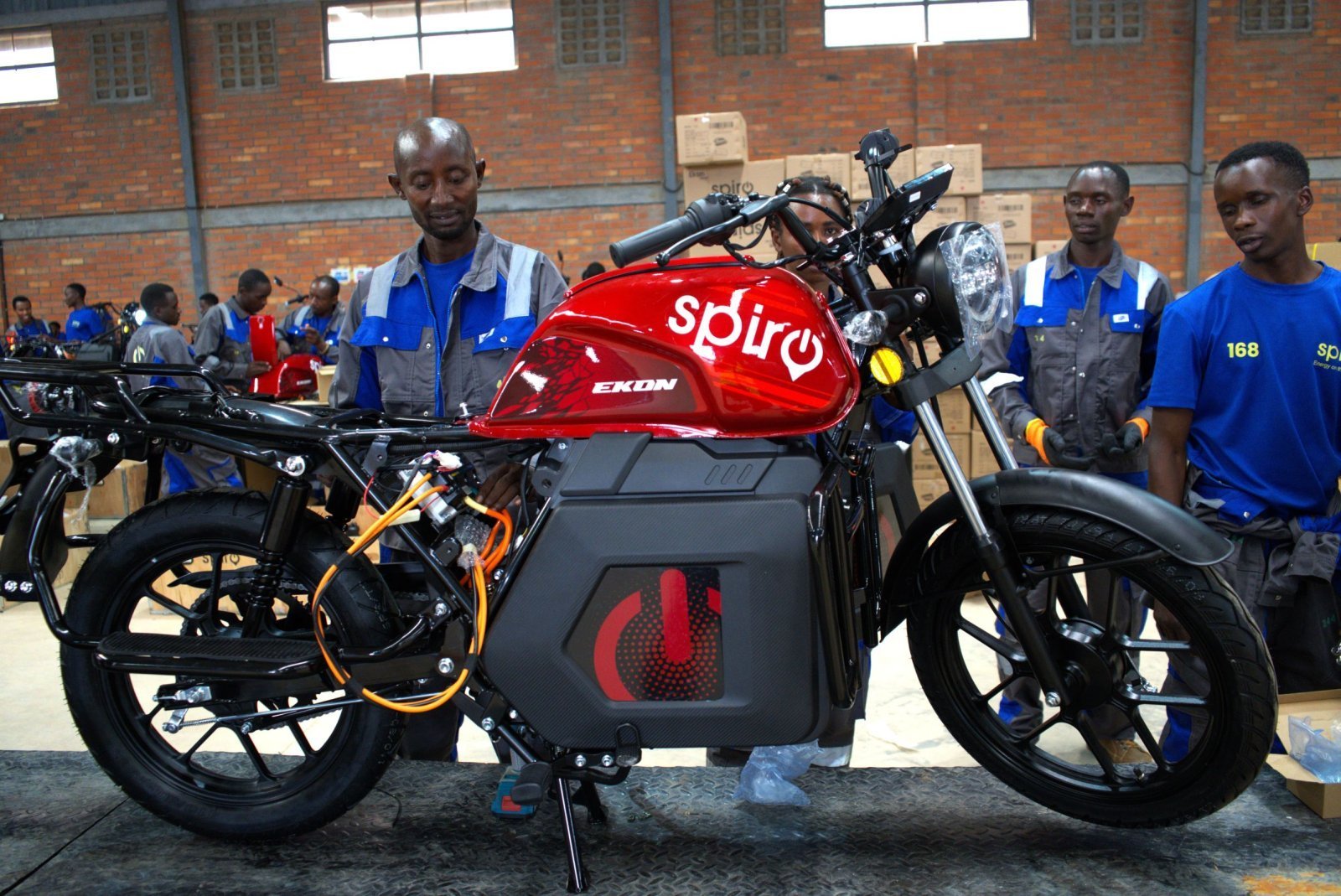
The manufacturing infrastructure whose development alongside the vehicle deployment distinguishes Spiro from a pure vehicle importer is concentrated in the East African markets whose industrial capacity Uchumi360's coverage has documented as the most rapidly developing on the continent. Spiro operates manufacturing plants in Kenya, Rwanda, and Uganda, building the local production capability whose presence reduces the import dependence that pure vehicle import models create and whose development creates the technical employment, supply chain relationships, and industrial learning that a genuine East African EV industry requires rather than a distribution operation for imported Asian electric motorcycles. A battery recycling facility in Nigeria completes the circular economy infrastructure whose presence makes the environmental case for Spiro's model as credible as the commercial case.
Why the battery-swap model works where conventional EV charging does not
The specific commercial innovation that has produced Spiro's 100,000 vehicle deployment across seven African markets is not the electric motorcycle itself, which Asian manufacturers have been producing at competitive prices for years, but the battery-swap model whose design solves the three specific barriers that conventional EV charging creates for the African urban two-wheeler rider whose daily economics and operational requirements are categorically different from the European or Chinese EV car driver whose charging behaviour the conventional model is designed around.
The first barrier is charging time. A bodaboda rider in Kampala, a delivery driver in Lagos, or a moto-taxi operator in Kigali earns income from vehicle movement. A four-hour charging stop is a four-hour income loss whose cost makes the switch from a gasoline motorcycle, which refuels in three minutes, to a conventional battery EV economically irrational regardless of the fuel cost saving the electric alternative produces across the operating day. A battery swap that exchanges a depleted battery for a fully charged one in the same three-minute window that gasoline refuelling requires eliminates the charging time barrier entirely, making the EV's operating cost advantage accessible without the operational disruption that the charging time would otherwise impose.
The second barrier is battery ownership cost. The battery in an electric motorcycle represents a substantial fraction of the vehicle's total cost and degrades over the charging cycles whose accumulation reduces the battery's capacity until replacement is required. A rider who owns the battery owns the degradation cost whose accumulation over three to five years of daily operation requires the capital for battery replacement that the daily income whose improvement the EV's operating cost saving produces may not accumulate fast enough to finance. Spiro's battery-swap model separates battery ownership from vehicle ownership, with Spiro maintaining the battery fleet whose condition the smart-swap station network monitors and manages, removing the battery degradation cost from the rider's financial exposure and converting it into the operating cost whose predictability the subscription or per-swap pricing model provides.
The third barrier is grid reliability. Conventional EV charging requires the reliable grid connection whose availability in African urban and peri-urban environments is improving but remains insufficient for the charging infrastructure that a large-scale conventional EV fleet would require. Spiro's smart-swap stations whose solar-powered development the company confirmed is underway reduce the grid dependency that conventional charging creates, making the battery-swap network operational in the energy environments that East and West African cities actually have rather than the energy environments that European EV infrastructure planning assumes.
According to Spiro's confirmed operational data, riders using its electric motorcycles cut daily transport costs by up to 40%, saving as much as USD 2 per day compared with conventional gasoline-powered motorcycles. In economies where the bodaboda rider's daily net income is frequently in the USD 5 to USD 15 range, a USD 2 daily saving represents a 13% to 40% income improvement whose materialisation across 100,000 riders is the household income effect whose aggregate economic significance the clean transport narrative frequently understates relative to the environmental benefit whose primacy the development finance community emphasises.
The DRC and Ethiopia expansion and what it means
The new USD 215 million funding will support Spiro's entry into the Democratic Republic of Congo and Ethiopia, the two largest population centres in sub-Saharan Africa that the current seven-market operational footprint does not yet serve, and whose combined urban two-wheeler market represents the largest single expansion opportunity available to an African electric mobility company whose unit economics the existing market deployment has validated.
The DRC's urban centres, particularly Kinshasa whose population of approximately 17 million makes it one of Africa's largest cities, and the eastern DRC's trading cities whose connectivity to the broader East African economic corridor that Uchumi360's coverage of the SGR, the Tanzania-DRC railway feasibility, and the critical minerals supply chain has documented, represent the electric mobility market whose characteristics match Spiro's battery-swap model most directly. High urban density creating the rider concentration that swap station network economics require, limited and unreliable grid infrastructure making the conventional charging model impractical, and the urban two-wheeler dominance in transport and delivery services providing the target customer base whose volume justifies the swap station investment are all present in the DRC's urban geography at the scale that makes the market entry commercially rational at the unit economics that the existing seven-market deployment has established.
Ethiopia's electric mobility market entry is separately significant for the East African EV narrative. According to available data, Ethiopia has been one of Africa's most active markets for electric vehicle policy development, with import duty exemptions for electric vehicles creating the policy environment that consumer adoption requires. An Spiro entry into Ethiopia adds the East African giant whose 120 million population and rapidly urbanising secondary cities create the volume potential that the battery-swap model's infrastructure investment requires to reach the network density whose achievement makes the consumer proposition most compelling.
The manufacturing and recycling infrastructure whose development matters as much as the vehicles
Spiro's manufacturing plants in Kenya, Rwanda, and Uganda are the component of the company's East African footprint whose long-term economic significance for the region extends beyond the clean transport benefit whose immediate visibility in reduced rider fuel costs is the commercial story the funding announcement leads with.
Local manufacturing is the industrial capability whose development Uchumi360's analysis of Tanzania's one-factory-per-day investment pace, Uganda's Kiira Motors electric bus manufacturing, and Rwanda's industrial investment programme has identified as the binding priority for East African economic transformation beyond commodity dependence. An EV manufacturing operation in Kenya, Rwanda, and Uganda that produces the electric motorcycles whose deployment the battery-swap network enables is contributing to the formal manufacturing employment, technical skills development, supply chain localisation, and industrial learning whose accumulation creates the productive complexity that distinguishes economies undergoing genuine industrial transformation from those achieving only extraction-based GDP growth.
The battery recycling facility in Nigeria adds the circular economy infrastructure whose development at scale is the environmental and economic prerequisite for a genuinely sustainable African EV industry. Battery recycling recovers the lithium, cobalt, nickel, and manganese whose mineral content represents a significant fraction of the battery's original cost and whose recovery through domestic recycling infrastructure reduces the import dependence on virgin mineral inputs and the export of end-of-life batteries to recycling facilities outside Africa that a recycling-absent EV deployment would otherwise produce. Africa holds the majority of the global cobalt and significant shares of the lithium and manganese whose processing into battery materials the global EV industry requires. Building the battery recycling infrastructure that closes the circular economy loop within Africa rather than exporting the end-of-life management offshore is the industrial development whose combination with the EV deployment whose batteries it recovers creates the full-cycle African EV industry rather than an African EV sales market for externally manufactured and recycled products.
The solar-powered swap stations and what they signal about Spiro's next phase
Spiro's development of solar-powered battery-swapping stations and second-life battery storage systems is the infrastructure evolution whose significance for the broader East African energy and transport architecture extends beyond Spiro's own commercial interests into the distributed energy infrastructure whose development the solar-swap station network represents at the community level.
A solar-powered battery swap station is simultaneously a clean transport infrastructure point and a distributed solar energy asset whose battery storage capacity, provided by the second-life batteries whose EV service life has ended but whose remaining capacity makes them commercially viable for stationary storage applications, creates the community energy storage that improves the reliability of solar energy in the off-grid and weak-grid environments where the swap station is most needed for transport and most valuable for energy simultaneously. The dual-purpose infrastructure whose development Spiro is pursuing converts the battery-swap station from a transport service point into a community energy hub whose presence improves transport access, reduces transport costs, provides distributed solar energy storage, and creates the local employment for the swap station operators and technicians whose management the network requires.
What the funding confirms about Africa's electric mobility trajectory
Lars Bo Bertram, CEO of Impact Fund Denmark, confirmed that the investment reflects confidence in Africa's electric mobility market. That confidence, expressed through a USD 215 million institutional equity commitment rather than the grant and concessional loan financing that development finance has historically directed toward African clean transport, is the market signal whose significance extends beyond Spiro's own funding round into the broader investment environment whose evolution from charity-model development finance toward commercial-returns institutional equity is the prerequisite for the scale of capital deployment that Africa's clean transport transition requires to move at the pace that the urban transport demand growth whose urgency the rising fuel prices and expanding city populations are creating demands.
Africa's electric mobility market remains smaller than China's and Europe's in absolute terms. According to available industry analysis, the sector is expanding quickly as governments introduce cleaner transport policies and startups develop business models tailored to local markets whose specific conditions, two-wheeler dominance, grid unreliability, income sensitivity, and operational continuity requirement, demand the innovation whose commercial expression the battery-swap model represents rather than the conventional charging infrastructure whose design reflects European and Chinese conditions rather than African ones.
The 100,000 electric vehicles that Spiro has deployed across seven markets are not a demonstration project. They are 100,000 riders whose daily transport costs have dropped by 40%, whose income has improved by as much as USD 2 per day, and whose collective adoption of the electric alternative has validated the commercial model that the USD 215 million institutional backing is funding to replicate across the continent at the scale that millions of riders rather than hundreds of thousands would represent.
Africa's EV story is not about Tesla. It is about the bodaboda rider in Kampala, the delivery driver in Lagos, and the moto-taxi operator in Kigali whose daily economic life improves the moment the petrol stop becomes a three-minute battery swap and the fuel cost becomes a 40% lower operating expense. USD 215 million says the model works at institutional investment scale. 100,000 electric vehicles on African roads says it has been working on the ground for longer than the funding announcement suggests.
FAQ
What did Spiro raise and what will it use the funding for? Spiro raised USD 215 million in equity financing from institutional investors in Europe and Africa including Denmark's Impact Fund. The funding will support expansion of its battery-swapping network, strengthening of local manufacturing and assembly operations in Kenya, Rwanda, and Uganda, and accelerated entry into new markets including the Democratic Republic of Congo and Ethiopia. The company did not disclose the valuation tied to the investment round.
What has Spiro already built across Africa? Spiro operates in seven markets: Kenya, Rwanda, Uganda, Togo, Benin, Nigeria, and Cameroon. Across those markets it has deployed 100,000 electric vehicles and 2,500 smart-swap stations. It operates manufacturing plants in Kenya, Rwanda, and Uganda and a battery recycling facility in Nigeria. The company is also developing solar-powered battery-swapping stations and second-life battery storage systems.
Why does the battery-swap model work better than conventional EV charging in Africa? Three specific barriers make conventional EV charging impractical for African urban two-wheeler riders: charging time of four or more hours creates an income loss that makes the switch from gasoline economically irrational; battery ownership cost places the degradation expense on the rider whose daily income cannot accumulate the replacement capital fast enough; and grid unreliability makes consistent charging impossible in many urban and peri-urban environments. Spiro's battery swap exchanges a depleted battery for a fully charged one in three minutes, removes battery ownership cost from the rider's exposure, and through solar-powered swap stations reduces grid dependence, solving all three barriers simultaneously.
How much do riders save by switching to Spiro? According to Spiro's confirmed operational data, riders cut daily transport costs by up to 40%, saving as much as USD 2 per day compared with conventional gasoline-powered motorcycles. In economies where urban two-wheeler riders earn USD 5 to USD 15 daily net income, a USD 2 saving represents a 13% to 40% income improvement whose materialisation across 100,000 riders produces a significant household income effect whose aggregate economic significance extends beyond the environmental benefit that clean transport advocacy typically emphasises.
What does the DRC and Ethiopia expansion mean for East Africa's EV market? The DRC's urban centres, particularly Kinshasa with approximately 17 million people, match Spiro's battery-swap model perfectly: high density, limited grid reliability, and two-wheeler dominance in urban transport. Ethiopia's electric vehicle policy environment, including import duty exemptions for EVs, creates the consumer adoption conditions that policy support enables. Together, the DRC and Ethiopia add two of sub-Saharan Africa's largest populations to Spiro's market footprint, significantly expanding the addressable market whose scale the USD 215 million funding is designed to serve at the unit economics that the seven-market deployment has validated.
 Uchumi360
Business Intelligence
Uchumi360
Business Intelligence
- Spiro, USD 215 million equity financing announcement, May 2026
- Seven markets, 100,000 EVs, 2,500 smart-swap stations, DRC and Ethiopia expansion plans, manufacturing plants in Kenya, Rwanda, Uganda, battery recycling facility Nigeria
- Gagan Gupta statement
- Available at spiro.com
- Impact Fund Denmark, investment confirmation
- Lars Bo Bertram statement
- Available at impactfund.dk
- AP News, Spiro USD 215 million raise reporting
- Available at apnews.com
- Rwanda Development Board, Rwanda EV manufacturing and clean transport policy data
- Available at rdb.rw
- Kenya National Bureau of Statistics, urban transport and two-wheeler market data
- Available at knbs.or.ke
- Uganda Bureau of Statistics, urban transport and bodaboda market data
- Available at ubos.org
- Nigeria Bureau of Statistics, electric vehicle and battery recycling data
- Available at nigerianstat.gov.ng
- Ethiopia Central Statistical Agency, electric vehicle policy and urban transport data
- Available at csa.gov.et
- DRC Institut National de la Statistique, Kinshasa urban population and transport data
- Available at ins-rdc.org
- USGS, Mineral Commodity Summaries
- Africa cobalt, lithium, and manganese reserves for battery recycling context
- Available at usgs.gov
- International Energy Agency, Africa electric mobility market data
- Available at iea.org
- GSMA, East Africa mobile money and financial inclusion data for income context
- Available at gsma.com
- African Development Bank, Africa clean transport and EV market research
- Available at afdb.org
- World Bank, Africa urban transport and fuel subsidy data
- Available at worldbank.org
- Tanzania Railways Corporation, SGR and Central Corridor connectivity context
- Available at trc.go.tz
- National Bureau of Statistics Tanzania, manufacturing and industrial data
- Available at nbs.go.tz
Uchumi360 covers business, investment, and economic policy across East, Central, and Southern Africa.
For the serious reader
You read to the end. That places you in a small group.
Uchumi360 is built for readers who demand precision over speed, structure over sentiment, and analysis that holds uncomfortable conclusions rather than softening them. If this work sharpens how you think about Africa's economy, help us keep building the infrastructure behind it.
Institutional Partners
Commission intelligence. Shape the conversation.
Uchumi360 works with development finance institutions, investment firms, sovereign bodies, and strategic organisations across the coverage region. Institutional partnership unlocks:
- Commissioned sector and country intelligence reports
- Branded research series under your institution's authority
- Exclusive data briefings for internal strategy teams
- Speaking and editorial presence at Uchumi360 events
- Co-published investment outlooks for your markets
Support Our Work
Independent analysis has a cost. Help us bear it.
Uchumi360 does not carry advertising. It does not take editorial direction from sponsors. Every article is produced without commercial compromise. Your contribution funds the reporting, research, and editorial infrastructure that keeps this analysis free from influence.
Secure checkout: One-time and monthly support are processed securely. Add payment credentials to enable checkout here.
Stay Connected
Keep up with every new insight.
Follow our latest analysis, policy coverage, and market intelligence as soon as it is published. If you need something specific, reach out directly and we will point you to the right research.
