
From Infrastructure to Factories: Why Manufacturing Is Back at the Centre of Tanzania's Economic Policy
Ready
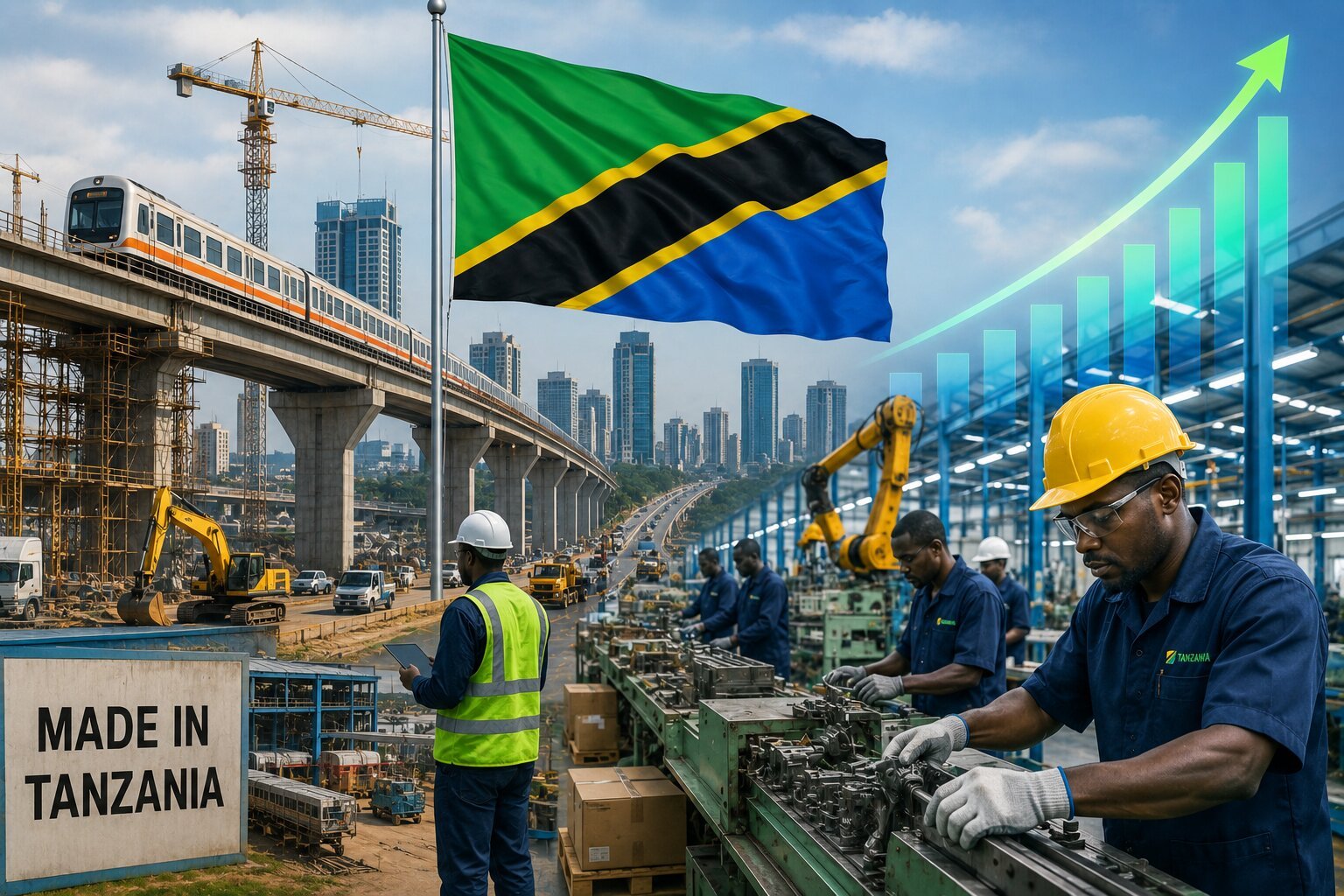
Tanzania manufacturing sector 2025: 5.9 percent GDP contribution, 5.2 percent growth, 397,953 workers up 1.7 percent from 391,275. Manufacturing exports to EAC: USD 1,264.6 million. Manufacturing exports to SADC: USD 3,545 million. FY2026/27 targets: manufacturing GDP contribution 7.44 percent rising to 8 percent by 2030, manufacturing growth 5.82 percent rising to 9.9 percent by 2030, manufacturing sector share of total exports rising from 9 to 15 percent by 2030. Key policy instruments: TISEZA manufacturing SEZ investment facilitation at 900+ approvals in 2025, Local Content promotion for domestic procurement preference, business environment reforms under MKUMBI II, Integrated Industrial Development Programme, KAIZEN productivity philosophy implementation. Key manufacturing investments: SINOVEST textile factory at Bagamoyo TZS 600 billion, Tanzol Solar Manufacturing Complex 300 workers and USD 300 million US exports, A1 Iron and Steel Dodoma TZS 600 billion, Mkulazi Sugar Factory 26,470 tonnes production in FY2025/26 season. Engaruka Soda Ash development TZS 2 billion in FY2026/27 budget. Tanzania spent a decade building the railways and ports that manufacturers need. Vision 2050's manufacturing agenda is about filling that infrastructure with production. The factories are being approved at record rates. The test is whether they convert from approvals to operating production.
DAR ES SALAAM — Tanzania's manufacturing sector contributed 5.9 percent of GDP in 2025, grew 5.2 percent, and exported USD 1,264.6 million to EAC markets and USD 3,545 million to SADC markets. The National Development Plan 2026/27 positions manufacturing as one of nine transformation sectors in Vision 2050 and sets targets for its GDP contribution, export share, and employment contribution that imply a structural acceleration in industrial activity beyond what the 2021 to 2025 period delivered.
What the infrastructure decade built for manufacturing
Tanzania's infrastructure decade delivered the logistics and energy infrastructure that manufacturing competitiveness requires. The SGR reduces transport costs for manufacturers moving goods from Dodoma, Tabora, and the western regions to Dar es Salaam port. The Julius Nyerere Hydropower Project at 2,115MW provides the baseload power whose reliability is a primary determinant of manufacturing location decisions. The TISEZA investment facilitation framework with 900-plus annual approvals creates the industrial land, services, and regulatory approval environment that investors require.
The manufacturing sector's 5.9 percent GDP contribution in 2025 is both the starting point and the constraint. Manufacturing has not grown as fast as mining, finance, or ICT during the infrastructure decade, in part because those sectors benefited more directly from the infrastructure investment itself and in part because manufacturing's growth requires the human capital, supply chain development, and technology transfer that take longer to accumulate than port or power plant construction.
The new policy instruments
Vision 2050's manufacturing agenda adds three policy instruments that the Vision 2025 framework did not use at the same scale.
Local content and domestic procurement requirements are the most direct. The plan explicitly identifies the need for a Local Content and Domestic Procurement Act that would require government agencies, large retailers, and major project contractors to source from domestic manufacturers in categories where production capacity exists. The policy logic, supported by the Maersk surcharge analysis Uchumi360 published, is that importing products Tanzania already manufactures wastes both foreign exchange and the capacity of the manufacturing base.
SEZs and industrial park development at seven identified locations, including Singida Manyoni, Pwani, Kigoma, Tanga, Manyara, Mara, and Ruvuma, complement the existing Benjamin William Mkapa SEZ, Bagamoyo SEZ, and Mtwara SEZ. The geographic distribution is intentional: industrial parks outside Dar es Salaam reduce the logistics cost disadvantage for manufacturers in secondary cities while building the regional economic diversification that concentrated coastal development has not delivered.
Digital manufacturing and KAIZEN productivity improvement are the productivity tools whose adoption the plan specifically targets. KAIZEN implementation, budgeted at TZS 100 million in FY2026/27 for facilitation across 50-plus manufacturing firms, addresses the within-firm productivity improvement that determines whether Tanzania's manufacturing wage cost advantage over Kenya and South Africa translates into competitive unit production costs.
The benchmark investments
Three investments illustrate the manufacturing policy's current expression at commercial scale.
The Mkulazi Sugar Factory in Kilosa produced 26,470 tonnes in the FY2025/26 season, 97.5 percent of its 27,139-tonne target, alongside 9,197 tonnes of molasses. Industrial-grade refined sugar is now being produced at pilot scale. The factory directly employs approximately 2,000 workers and contracts 304 smallholder cane growers.
The SINOVEST textile factory at Bagamoyo, confirmed by TISEZA at 5,000 direct jobs, is the apparel and textile investment whose labour intensity best matches Tanzania's demographic structure. Every textile factory job is a formal sector job for a worker who would otherwise be in the informal economy.
The A1 Iron and Steel Dodoma plant at TZS 600 billion, using domestic iron ore, is the beneficiation investment that converts a raw material Tanzania currently exports into a manufactured product Tanzania currently imports. Its 15-month construction timeline means production could begin by late 2027 if the July 2026 start date is achieved.
 Uchumi360
Business Intelligence
Uchumi360
Business Intelligence
Uchumi360 covers business, investment, and economic policy across East, Central, and Southern Africa.
For the serious reader
You read to the end. That places you in a small group.
Uchumi360 is built for readers who demand precision over speed, structure over sentiment, and analysis that holds uncomfortable conclusions rather than softening them. If this work sharpens how you think about Africa's economy, help us keep building the infrastructure behind it.
Institutional Partners
Commission intelligence. Shape the conversation.
Uchumi360 works with development finance institutions, investment firms, sovereign bodies, and strategic organisations across the coverage region. Institutional partnership unlocks:
- Commissioned sector and country intelligence reports
- Branded research series under your institution's authority
- Exclusive data briefings for internal strategy teams
- Speaking and editorial presence at Uchumi360 events
- Co-published investment outlooks for your markets
Support Our Work
Independent analysis has a cost. Help us bear it.
Uchumi360 does not carry advertising. It does not take editorial direction from sponsors. Every article is produced without commercial compromise. Your contribution funds the reporting, research, and editorial infrastructure that keeps this analysis free from influence.
Secure checkout: One-time and monthly support are processed securely. Add payment credentials to enable checkout here.
Stay Connected
Keep up with every new insight.
Follow our latest analysis, policy coverage, and market intelligence as soon as it is published. If you need something specific, reach out directly and we will point you to the right research.
