
Africa Holds the Minerals That Power the 21st Century. It Is Still Exporting Them Raw and Importing Back the Value.
Ready
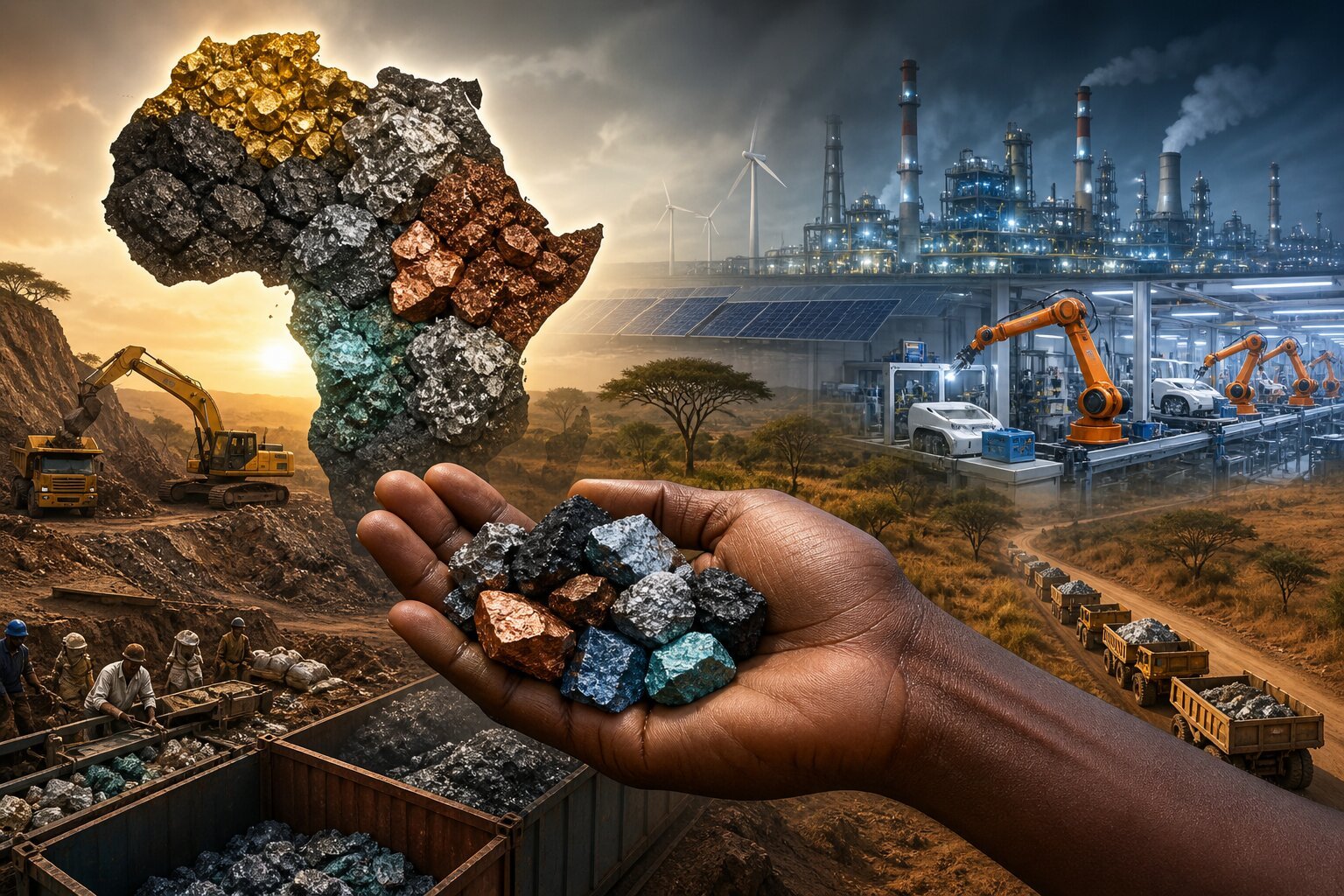
Africa's critical minerals endowment is the most consequential resource story of the 21st century for the same reason that Gulf oil was the most consequential resource story of the 20th: supply concentration in a small number of geographies creates structural leverage over industrial systems that depend on those inputs. The difference is not the commodity. It is that the world now knows in advance what the dependency looks like and what it costs, and Africa's governments have the analytical clarity and the multilateral standing to negotiate differently than their predecessors did when oil revenues first began flowing. This article identifies the three structural forces defining the critical minerals system, benchmarks Africa's current position against the oil era template it is repeating, and assesses what processing sovereignty would actually require to convert mineral concentration into retained economic value rather than another generation of raw material export.
The argument that critical minerals represent a new opportunity for Africa is analytically correct and historically incomplete, because the opportunity it describes is structurally identical to the opportunity that oil represented for the Gulf, gas for Russia, and copper for Zambia across the second half of the 20th century, all of which produced revenue flows, geopolitical attention, and external capital commitments without producing the industrialisation, institutional development, or economic diversification that proximity to a globally critical resource implies but does not guarantee. According to the United States Geological Survey's Mineral Commodity Summaries 2024, the Democratic Republic of Congo accounts for approximately 74% of global cobalt production, a concentration whose supply chain significance for battery manufacturing, electric vehicles, and consumer electronics is more consequential today than at any previous point in the commodity's history. South Africa and Zimbabwe together supply more than 80% of platinum group metals globally, according to the same USGS data, while African countries hold dominant positions in manganese, tantalum, chromite, and graphite whose industrial applications in steel production, electronics, aerospace, and energy storage make them genuinely non-substitutable in their primary use cases. These are not marginal resource positions. They are structural dependencies whose geographic concentration gives African host governments theoretical leverage of precisely the kind that oil producers in the Gulf exercised through OPEC across four decades of coordinated supply management, and which those same governments have rarely converted into industrial sovereignty.
The reason the critical minerals system is best understood as the oil system with a different input is that the structural relationships among resource geography, external capital, processing jurisdiction, and value distribution have not changed, even as the commodity and its industrial applications have. According to the International Energy Agency's Critical Minerals Market Review 2023, the processing of most critical minerals is concentrated in China, which refines approximately 60% of global lithium, 70% of cobalt, and more than 80% of rare earth elements, despite holding a minority share of the primary mining position in several of those categories. The value added in processing, which according to BloombergNEF analysis converts a tonne of lithium carbonate worth approximately USD 20,000 into battery cells worth several multiples of that figure, accrues in the jurisdiction where processing occurs, not where the ore is mined. Africa mines the cobalt. China refines it. South Korea and Japan manufacture the battery cells. The United States and Germany install those cells in electric vehicles whose retail value captures the cumulative margin of every processing stage that occurred outside the continent where the primary resource originated. This is not a new economic arrangement. It is the colonial commodity structure expressed through a different set of inputs at a higher level of strategic importance.
The three forces that define the system and where Africa sits within each
The critical minerals system is organised around three structural forces whose interaction determines how value is distributed among the countries that participate in it, and Africa's position within each force is currently more favourable than it was during the oil era while remaining structurally disadvantaged relative to the processing and manufacturing jurisdictions that capture the largest share of value.
Supply concentration is the first and most immediately legible force. According to the USGS, cobalt production in the DRC, copper production in Zambia and the DRC, platinum group metals in South Africa and Zimbabwe, graphite in Mozambique and Tanzania, lithium in Zimbabwe and emerging deposits across Mali and the broader Sahel, and rare earth occurrences documented across Southern and Eastern Africa collectively give the continent a supply position in the minerals that power energy transition, advanced manufacturing, and defence systems that is without parallel in any other region. According to the African Development Bank's African Economic Outlook 2023, Africa holds approximately 30% of the world's known mineral reserves across all categories, with the critical minerals subset disproportionately concentrated on the continent relative to the global reserve distribution for other commodity categories. Supply concentration of this degree creates the precondition for leverage, but does not deliver leverage automatically, because leverage requires the willingness and the institutional capacity to exercise it, both of which depend on factors that exist outside the resource endowment itself.
External capital is the second structural force, and it operates in the critical minerals system in ways that are more sophisticated but not fundamentally different from the oil system's investment architecture. According to the Johns Hopkins University School of Advanced International Studies China Africa Research Initiative's 2023 annual data, Chinese state-connected companies hold equity stakes, offtake agreements, or processing contracts across cobalt, copper, lithium, and manganese projects in the DRC, Zambia, Zimbabwe, the Democratic Republic of Congo, and Mozambique that give them effective supply chain control over a share of African mineral production that exceeds China's formal equity ownership. The European Union's Critical Raw Materials Act, adopted in 2024 and documented in the European Commission's official legislative record, establishes a framework for strategic partnerships with African mineral producers that is designed to diversify European supply chain exposure away from Chinese concentration, but which has not yet demonstrated the financing volume or the commercial terms that would make it a genuine alternative to Chinese capital for large-scale African mineral development projects. According to Reuters reporting on the US critical minerals strategy in Africa in 2025 and 2026, the Trump administration has been pursuing bilateral mineral access agreements, as Zambia's Foreign Minister Mulambo Haimbe confirmed publicly on 4 May 2026, under terms that Uchumi360's May 2026 analysis documented as conditioning health development financing on minerals access commitments, a conditionality architecture that reflects the same instrumental use of development assistance that characterised Western engagement with African oil producers during the 1970s and 1980s.
Geopolitical competition is the third structural force, and it is intensifying at a pace that creates both opportunity and risk for African mineral producers simultaneously. The competition among the United States, China, and the European Union for critical mineral supply chain security is not primarily about the minerals themselves, though the minerals are its substance. It is about control of the upstream inputs to industrial systems whose domestic production capacity each of the major powers is attempting to rebuild or defend following the supply chain disruptions of 2020 to 2022, which demonstrated the systemic vulnerability of globalised manufacturing to geographic concentration risk in ways that no strategic planning document had previously made politically actionable. According to the IEA's World Energy Outlook 2023, meeting the net-zero emissions targets that the Paris Agreement frameworks require would demand approximately six times the current level of critical mineral production by 2040, a demand trajectory that no existing supply pipeline can satisfy without substantial new African production, which means that African governments will be negotiating mineral access agreements with increasingly urgent external partners across a window in which their leverage is structurally greater than at any previous point in the post-independence period.
The doctrine has not changed even though the strategic importance has
The export pattern that defines Africa's current position in the critical minerals system, mining primary ore and exporting it with minimal processing for value addition to occur in refining and manufacturing jurisdictions in China, Europe, and North America, is the operational expression of a developmental doctrine that African governments, international financial institutions, and external investors have collectively sustained across the commodities cycle despite its documented failure to produce industrialisation in any African economy that has relied on it as a primary growth mechanism. According to the United Nations Conference on Trade and Development's Economic Development in Africa Report 2023, Africa's share of global manufacturing value added has remained below 3% for two decades despite the continent's growing share of global resource production, a divergence that reflects the processing gap between where minerals are extracted and where they are transformed into the intermediate and finished goods that carry the majority of the value chain's economic return.
Nigeria's oil sector is the most extensively documented African example of what resource concentration without processing sovereignty produces across a multi-decade horizon. According to the World Bank's Nigeria Economic Update series, Nigeria produced and exported crude oil for more than six decades while simultaneously importing refined petroleum products whose domestic demand it was technically capable of meeting through domestic refining, paying the refining margin to external processors on each barrel it exported and then re-imported in finished form. The Dangote Refinery, whose 650,000 barrel per day capacity according to Reuters' 2023 commissioning coverage began addressing this structural absurdity only in 2023, demonstrates both what processing sovereignty looks like when private capital commits to it at scale and how long it takes to arrive when the policy environment does not compel it. The DRC's cobalt sector is currently at an earlier stage of the same developmental arc, exporting the majority of its cobalt in hydroxide or partially processed form for refining in China according to Benchmark Mineral Intelligence's cobalt supply chain analysis, capturing a fraction of the value that the battery cells manufactured from that cobalt will eventually represent in electric vehicle markets.
What processing sovereignty would actually require
The conditions that would convert Africa's critical minerals concentration into retained economic value rather than another generation of raw material export are specific, demanding, and partially within the control of individual governments while remaining partly dependent on international trade architecture, technology access, and financing availability that individual governments cannot unilaterally determine. According to the African Union's Africa Mining Vision, adopted in 2009 and updated in subsequent implementation frameworks, the pathway from resource extraction to industrial development requires value chain integration requirements embedded in licensing frameworks, domestic beneficiation infrastructure financed at the scale that meaningful processing investment demands, human capital development aligned with the technical requirements of refining and manufacturing operations, and energy infrastructure whose reliability and cost structure makes processing economically competitive with the jurisdictions that currently dominate it.
Zimbabwe's Finance Ministry announced in 2022, according to Reuters' reporting at the time, a ban on lithium ore exports designed to compel domestic processing investment, a regulatory intervention that produced mixed results in the short term but that established the principle that a government with sovereign control over its mineral licensing framework can condition access on processing commitments rather than accepting the extraction-only model that external capital prefers. Tanzania's approach to its critical minerals portfolio, including the state participation framework applied to the Songwe Helium project documented in Uchumi360's May 2026 analysis and the local content requirements embedded in the Mining Act 2010, represents a similar attempt to use the licensing architecture to capture more of the value chain domestically rather than exporting the raw resource and the value added by its transformation simultaneously. Rwanda's mandatory processing requirements in its coltan and tin sectors, documented in the Rwanda Development Board's Annual Report 2025, have produced domestic refining capability incrementally over more than a decade and represent the most sustained regional example of value chain policy producing structural change rather than political statement.
None of these interventions has yet produced the processing sovereignty that would fundamentally alter Africa's position in global critical mineral supply chains, because processing at the scale required to capture refining margin from cobalt, lithium, or rare earth production requires energy infrastructure, technical workforce depth, and capital commitment that exceeds what individual government licensing decisions can compel without the complementary investments in electricity generation, vocational education, and long-tenor industrial financing that processing competitiveness requires. According to the International Monetary Fund's Regional Economic Outlook for Sub-Saharan Africa published in October 2023, the energy access gap, measured as the share of industrial and commercial users with reliable electricity at competitive prices, remains the single most binding constraint on manufacturing competitiveness across the continent, a constraint that is particularly acute for mineral processing operations whose energy intensity makes electricity cost a primary determinant of refining economics.
The geopolitical window and what it actually offers
The competition among the United States, China, and the European Union for critical mineral supply chain security creates a negotiating environment for African mineral producers that is more favourable than at any previous point in the post-independence period, but it creates favourable conditions rather than guaranteeing favourable outcomes, because the conversion of favourable conditions into retained economic value requires the institutional capacity, the policy coherence, and the political will to negotiate on the merits of each agreement rather than accepting the terms that external partners prefer. Zambia's public rejection of the US conditionality architecture on 4 May 2026, as documented in Uchumi360's analysis of Foreign Minister Haimbe's official statement to Reuters, demonstrated that African governments can exercise the leverage that their mineral position implies when they have the institutional capacity to articulate their position clearly and the political will to sustain it against external pressure. Tanzania's diversified financing structure for its SGR and LNG investments, its state participation framework for the Songwe Helium project, and its engagement with multiple competing external partners for its critical minerals portfolio all reflect versions of the same strategic logic applied across different sectors simultaneously.
The window in which this leverage is most available is not unlimited. As the IEA's Critical Minerals Market Review documents, the investment decisions made between 2024 and 2030 will determine the supply chain architecture for critical minerals across the 2030 to 2050 period, because the capital commitments, processing facility construction timelines, and offtake agreements being finalised in this period will lock in supply chain relationships that are operationally expensive to restructure once infrastructure is built and commercial contracts are in force. African governments that negotiate processing requirements, value chain integration conditions, and equity participation structures into their critical mineral agreements during this window will be negotiating from a position of scarcity that will not persist indefinitely, because the same technological development that makes African minerals strategically critical in 2026 is also driving investment in recycling, substitution, and alternative material development that will gradually reduce the supply concentration leverage that African mineral positions currently provide.
Critical minerals are not the new oil. They are the same system with a different input and a narrower window for the producer geographies to alter the terms on which they participate in it. Africa mined the resources that powered the 20th century and retained a fraction of the value they created. The question that the 21st century's resource system poses is not whether Africa will do the same with the minerals that power it. The question is whether the governments, institutions, and private sector actors who collectively determine Africa's position in that system will use the leverage that supply concentration provides, in this specific window when external demand is urgent and alternative supply is genuinely scarce, to embed processing sovereignty into the commercial architecture of critical mineral development before the architecture is locked in and the leverage is gone.
FAQ
Why are critical minerals described as the same system as oil rather than a new opportunity? Because the structural relationships that determine how value is distributed among resource producers, processing jurisdictions, and manufacturing economies are identical in both systems. Supply is concentrated in Africa, capital is external, processing occurs elsewhere, and the majority of value chain margin accrues in the jurisdictions where transformation into intermediate and finished goods happens. According to UNCTAD's Economic Development in Africa Report 2023, Africa's share of global manufacturing value added has remained below 3% for two decades despite its growing share of global resource production, the same divergence that characterised the oil era.
Which African countries hold the most significant critical mineral positions? According to the USGS Mineral Commodity Summaries 2024, the DRC holds approximately 74% of global cobalt production, South Africa and Zimbabwe together supply more than 80% of platinum group metals, and Mozambique and Tanzania hold significant graphite reserves. Zimbabwe and Mali hold lithium deposits whose development is accelerating, and rare earth occurrences are documented across Southern and Eastern Africa. Zambia and the DRC together hold copper reserves whose scale makes them critical for electrification infrastructure globally.
What would processing sovereignty actually require for African mineral producers? According to the African Union's Africa Mining Vision framework, processing sovereignty requires value chain integration conditions embedded in licensing frameworks before capital is committed, domestic beneficiation infrastructure financed at industrial scale, technical workforce development aligned with refining requirements, and energy infrastructure at a cost and reliability standard that makes processing economically competitive with Chinese and European refining jurisdictions. Zimbabwe's lithium export ban of 2022 and Rwanda's mandatory coltan processing requirements documented in the RDB Annual Report 2025 are the most direct current examples of this logic applied in practice.
Why is the current geopolitical window described as time-limited? According to the IEA's World Energy Outlook 2023, the investment decisions made between 2024 and 2030 will determine the critical mineral supply chain architecture for the 2030 to 2050 period. Commercial contracts, processing facility construction, and offtake agreements finalised in this window are operationally expensive to restructure once in force. Additionally, the same technological development driving demand for African minerals is also advancing recycling, substitution, and alternative material research that will gradually reduce supply concentration leverage over a multi-decade horizon.
How does the US-Zambia minerals dispute relate to this broader structural argument? It is the most recent and most explicitly documented example of external powers using development financing as leverage instruments to secure mineral access commitments on terms that African governments would be less willing to grant if negotiations were conducted purely on commercial or geopolitical grounds. Zambia's Foreign Minister Haimbe confirmed publicly on 4 May 2026, according to Reuters, that the US conditioned a USD 2 billion health funding offer on a separate critical minerals agreement granting preferential access to US companies. Zambia's rejection demonstrated that the leverage African mineral producers hold is real and exercisable, provided governments have the institutional capacity and political will to use it.
 Uchumi360
Business Intelligence
Uchumi360
Business Intelligence
- United States Geological Survey, Mineral Commodity Summaries 2024
- DRC cobalt share, South Africa and Zimbabwe platinum group metals share, and other supply concentration figures cited from this primary source
- Available at usgs.gov
- International Energy Agency, Critical Minerals Market Review 2023
- China's refining share for lithium, cobalt, and rare earths cited from this report
- Available at iea.org
- IEA, World Energy Outlook 2023
- Sixfold mineral demand increase projection to 2040 under net-zero scenarios
- Available at iea.org
- BloombergNEF, battery supply chain and lithium carbonate pricing analysis, 2023 to 2024
- Lithium carbonate to battery cell value conversion cited as an illustrative benchmark
- Johns Hopkins SAIS China Africa Research Initiative, annual data 2023
- Chinese equity and offtake positions in African critical mineral projects
- Available at sais-cari.org
- European Commission, Critical Raw Materials Act, 2024
- Official legislative text available at ec.europa.eu
- African Development Bank, African Economic Outlook 2023
- Africa's 30% share of global mineral reserves
- Available at afdb.org
- UNCTAD, Economic Development in Africa Report 2023
- Africa's share of global manufacturing value added below 3%
- Available at unctad.org
- World Bank, Nigeria Economic Update series
- Nigeria refined petroleum import dependency
- Available at worldbank.org
- Reuters, Dangote Refinery commissioning coverage, 2023
- 650,000 barrel per day capacity confirmed
- Benchmark Mineral Intelligence, cobalt supply chain analysis
- DRC cobalt export form and Chinese refining share
- Rwanda Development Board, Annual Report 2025
- Rwanda mandatory processing requirements in coltan and tin
- IMF, Regional Economic Outlook Sub-Saharan Africa, October 2023
- Energy access gap as manufacturing competitiveness constraint
- Available at imf.org
- African Union, Africa Mining Vision, 2009 and subsequent implementation frameworks
- Available at au.int
- Reuters, Zimbabwe lithium export ban reporting, 2022
Uchumi360 covers business, investment, and economic policy across East, Central, and Southern Africa.
For the serious reader
You read to the end. That places you in a small group.
Uchumi360 is built for readers who demand precision over speed, structure over sentiment, and analysis that holds uncomfortable conclusions rather than softening them. If this work sharpens how you think about Africa's economy, help us keep building the infrastructure behind it.
Institutional Partners
Commission intelligence. Shape the conversation.
Uchumi360 works with development finance institutions, investment firms, sovereign bodies, and strategic organisations across the coverage region. Institutional partnership unlocks:
- Commissioned sector and country intelligence reports
- Branded research series under your institution's authority
- Exclusive data briefings for internal strategy teams
- Speaking and editorial presence at Uchumi360 events
- Co-published investment outlooks for your markets
Support Our Work
Independent analysis has a cost. Help us bear it.
Uchumi360 does not carry advertising. It does not take editorial direction from sponsors. Every article is produced without commercial compromise. Your contribution funds the reporting, research, and editorial infrastructure that keeps this analysis free from influence.
Secure checkout: One-time and monthly support are processed securely. Add payment credentials to enable checkout here.
Stay Connected
Keep up with every new insight.
Follow our latest analysis, policy coverage, and market intelligence as soon as it is published. If you need something specific, reach out directly and we will point you to the right research.
