
The Economics of African Borders: How Delays, Fees and Informality Are Giving Way to a New Era of Regional Trade
Ready
Africa’s borders were inherited as lines of separation. The next generation of integration is turning them into instruments of scale. That is the new economics of African borders.
Africa’s borders were once designed to divide markets that naturally belonged together. They separated families, trading communities, livestock routes, food systems, languages, ports, production zones and mineral corridors. They turned neighbours into customs territories and ancient commercial routes into formal checkpoints.
Now, slowly but decisively, Africa is trying to turn those same borders into bridges.
This is the more important story. The continent’s border economy has long been associated with delays, paperwork, fees, informality and mistrust. But across East, Southern, West and Central Africa, a new infrastructure of integration is taking shape: one-stop border posts, digitised customs, local-currency payment systems, simplified trade regimes, regional corridors and the African Continental Free Trade Area.
The old African border slowed trade. The emerging African border is being redesigned to move it.
That shift matters because Africa’s economic future depends not only on what it produces, but on how easily that production moves across the continent. A farmer in Tanzania should be able to supply a buyer in Kenya without losing margin to delays. A manufacturer in Uganda should be able to reach Rwanda, Democratic Republic of Congo and South Sudan without treating each border as a new battle. A trader in Zambia should be able to sell into Malawi without being punished by currency friction. A cosmetics producer in Ghana should eventually see Côte d’Ivoire, Nigeria and Senegal not as foreign markets, but as reachable African customers.
That is the promise of the new African trade architecture.
The African Continental Free Trade Area is the centrepiece. The World Bank has estimated that full implementation of the agreement could raise regional income by USD 450 billion by 2035 and lift 30 million people out of extreme poverty. It has also projected a major increase in intra-African exports if the agreement is implemented with supporting reforms.
The agreement is not only a trade deal. It is a psychological reordering of Africa’s economy. It asks the continent to stop seeing neighbouring countries as small, separate markets and start seeing them as parts of one production system.
The need is urgent. Afreximbank’s African Trade Report 2025 shows that Africa’s merchandise trade recovered by 13.9% in 2024 to USD 1.5 trillion, while intra-African trade grew by 12.4% to USD 220.3 billion. That growth is encouraging. It shows that African trade is not stagnant. But it also shows how much work remains. Africa still accounts for only a modest share of global exports, and too much of its trade remains externally oriented.
This is where borders become central. A continental free trade area cannot function if goods are stopped by slow paperwork, duplicate inspections, inconsistent standards, informal payments and poor corridor systems. The treaty creates the market. Border reform makes the market usable.
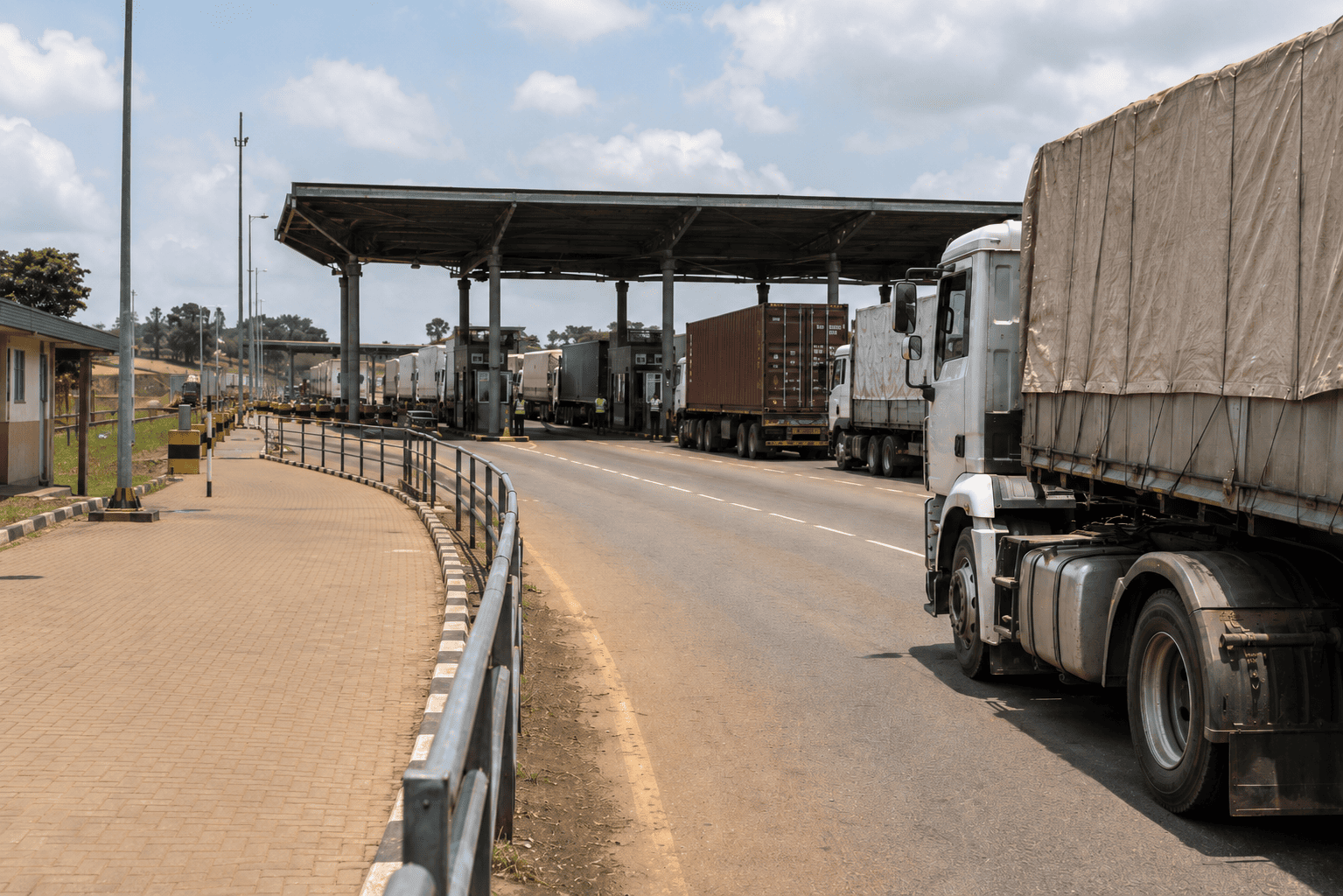
East Africa offers one of the clearest examples of progress. The East African Community has rolled out more than 15 one-stop border posts, which allow border agencies from neighbouring countries to coordinate clearance in one facility. TradeMark Africa reported that these facilities have reduced border-crossing times by about 70% and generated more than USD 63 million in annual savings.
That is Pan-Africanism with an invoice attached. It is not symbolic unity. It is money saved, time recovered and trade made easier.
The one-stop border post model changes the old border logic. Instead of stopping once to exit one country and again to enter another, people and goods are processed through a coordinated system. The East African Community’s own sustainability strategy frames one-stop border posts as tools for reducing the time and cost of crossing borders, built around harmonised procedures, information technology, data exchange and functional infrastructure.
This is what integration looks like when it leaves the summit hall and enters the road network.
The benefits are practical. A transporter saves fuel and driver time. A farmer reduces spoilage. A manufacturer receives inputs faster. A wholesaler manages inventory better. A consumer eventually pays less than they would in a system where every delay becomes part of the final price.
For landlocked countries, the gains are even more strategic. Uganda, Rwanda, Burundi, South Sudan, Zambia, Malawi, Niger, Mali, Chad and Burkina Faso do not have the luxury of inefficient corridors. Their trade competitiveness depends on neighbours. A faster border is not just administrative reform. It is economic oxygen.
This explains why corridor development is becoming one of the most important Pan-African economic projects. The Northern Corridor, Central Corridor, Maputo Corridor, Walvis Bay Corridor, Abidjan-Lagos Corridor, North-South Corridor and Lobito Corridor are not just roads, ports and railways. They are the arteries of a future African market. Their performance will determine whether the continent can build regional value chains in food, pharmaceuticals, construction materials, textiles, energy equipment, automotive components and processed goods.
The best version of African integration will not erase borders. It will make them intelligent.
That means customs systems that communicate, standards agencies that trust one another, transport authorities that share cargo data, immigration systems that process legitimate movement faster, and payment systems that settle transactions without forcing every trader through expensive currency conversions.
Payment interoperability is already becoming part of this new border economy. In October 2025, the Common Market for Eastern and Southern Africa launched a Digital Retail Payments Platform to support cross-border trade in local currencies. Reuters reported that the system began with a Malawi-Zambia corridor trial and was designed to reduce transaction costs by avoiding unnecessary United States dollar conversions. It is aimed especially at small and medium-sized enterprises, which represent about 80% of businesses and 60% of employment in the region.
This is a quiet revolution. Borders are not only customs points. They are also payment points. If an African trader clears goods faster but loses money through currency conversion, settlement delays or dollar dependency, integration remains incomplete. Local-currency payment systems and the wider Pan-African Payments and Settlement System are therefore part of the same liberation of African trade.
The future of intra-African trade will be built through these layers: physical corridors, digital customs, interoperable payments, harmonised standards and regional trust.
There is also a social dimension that should not be missed. African trade is not carried only by large logistics companies and container trucks. It is also carried by women and small traders crossing borders with food, clothes, household goods, agricultural produce and daily necessities. The United Nations Conference on Trade and Development has shown that women play a major role in informal cross-border trade and often face constraints linked to finance, mobility, information, lengthy clearance processes and weak border governance. In its work on small-scale cross-border trade, it found that about 70% of informal traders in the studied settings crossed borders exclusively on foot.
A positive Pan-African trade agenda must therefore include small traders, not merely tolerate them. The woman carrying produce across a border is not an informal inconvenience. She is part of Africa’s oldest commercial infrastructure. She links households, stabilises food flows and keeps border economies alive.
The task is to bring such traders into safer, cheaper and more recognised systems. Simplified trade regimes, clear thresholds for low-value consignments, transparent fees, safe crossing points, digital identity, mobile payments and trader education can turn informality into structured participation.
That is how integration becomes inclusive.
The African Continental Free Trade Area’s early implementation shows that the continent is beginning to move from policy signature to actual transaction. Reuters reported in 2025 that the agreement had been ratified by 49 countries and that 24 countries, including South Africa and Nigeria, were actively trading under it. The same report cited World Bank projections that the agreement could boost intra-African exports by 81%, while Afreximbank data showed intra-African trade rising 12.4% in 2024.
That matters because Africa’s external trade environment is becoming more uncertain. Global tariff disputes, supply-chain nationalism, geopolitical fragmentation and climate-linked trade rules are all pushing the continent to look inward with more seriousness. Intra-African trade is no longer only a Pan-African dream. It is a resilience strategy.
The more Africa trades with itself, the less exposed it becomes to external shocks. The more African manufacturers sell into neighbouring markets, the more viable local production becomes. The more African ports, roads, railways and border systems connect to one another, the more competitive landlocked economies become. The more African payment systems settle in local currencies, the less vulnerable small traders are to dollar friction.
This is why the border is becoming one of the most important frontiers of African development.
The old politics of borders was about control. The new economics of borders is about flow.
That does not mean the challenges have disappeared. Many crossings still suffer from slow paperwork, poor coordination, weak internet, informal charges, inconsistent standards, limited operating hours and under-equipped agencies. Some reforms work well in one corridor but not in another. Some border posts have new buildings but old habits. Some digital systems do not talk to each other. Some small traders still face harassment.
But the direction is no longer static. Africa is not starting from zero. The continent is learning, building and integrating.
The next phase is interoperability.
A border post that works in Kenya and Uganda must speak to systems in Rwanda and Tanzania. A product certificate issued in one country should be trusted in another where standards are aligned. A trader using local-currency settlement in one corridor should eventually be able to transact across several regional blocs. Customs data should move before the truck arrives. Risk-based inspections should replace blanket suspicion. Agencies should share information instead of multiplying queues.
This is the administrative grammar of a real African market.
Bilateral action will remain crucial. Countries that share borders must solve practical commercial problems together: truck queues, axle-load rules, scanning capacity, phytosanitary checks, customs operating hours, insurance recognition, cargo tracking and small-trader documentation. Pan-African integration succeeds when neighbours solve the problems in front of them.
The continent’s development partners, regional institutions and private sector also have roles to play. Development finance can support border infrastructure and trade systems. Banks can design better products for cross-border traders. Logistics companies can build reliable corridor services. Technology firms can digitise documentation and payments. Chambers of commerce can track non-tariff barriers. Governments can publish border-performance data and make officials accountable for delays.
That last point matters. What is measured improves. Africa should track border-crossing times, clearance costs, resolved non-tariff barriers, small-trader participation, local-currency settlement volumes and corridor reliability with the same seriousness it tracks gross domestic product.
The purpose is not to remove regulation. Borders must still protect public health, security, tax systems, food safety and national law. The purpose is to make the regulation intelligent enough not to punish legitimate trade.
A faster border does not mean a weaker border. It means a smarter one.
Africa’s borders can become engines of integration rather than monuments to fragmentation. The same lines that once separated markets can now connect them, if supported by technology, trust, infrastructure and political will.
The prize is large. A continent-sized market gives African manufacturers a reason to scale. It gives farmers more buyers. It gives small traders safer routes. It gives landlocked countries better access. It gives young businesses regional ambition. It gives African states more bargaining power in global trade.
The future of African borders will not be decided by speeches about unity alone. It will be decided by whether a truck waits for hours or minutes, whether a trader pays one transparent fee or several informal ones, whether a product certificate is recognised across the border, whether payments settle quickly, and whether a small business can sell beyond its national market without being crushed by paperwork.
The continental market is being built at the border post. Not as a slogan, but as a cleared truck, a recognised certificate, a settled payment, a safer trader, a faster corridor, and a product moving from one African country to another with confidence.
Africa’s borders were inherited as lines of separation. The next generation of integration is turning them into instruments of scale. That is the new economics of African borders.
 Uchumi360
Business Intelligence
Uchumi360
Business Intelligence
Uchumi360 covers business, investment, and economic policy across East, Central, and Southern Africa.
For the serious reader
You read to the end. That places you in a small group.
Uchumi360 is built for readers who demand precision over speed, structure over sentiment, and analysis that holds uncomfortable conclusions rather than softening them. If this work sharpens how you think about Africa's economy, help us keep building the infrastructure behind it.
Institutional Partners
Commission intelligence. Shape the conversation.
Uchumi360 works with development finance institutions, investment firms, sovereign bodies, and strategic organisations across the coverage region. Institutional partnership unlocks:
- Commissioned sector and country intelligence reports
- Branded research series under your institution's authority
- Exclusive data briefings for internal strategy teams
- Speaking and editorial presence at Uchumi360 events
- Co-published investment outlooks for your markets
Support Our Work
Independent analysis has a cost. Help us bear it.
Uchumi360 does not carry advertising. It does not take editorial direction from sponsors. Every article is produced without commercial compromise. Your contribution funds the reporting, research, and editorial infrastructure that keeps this analysis free from influence.
Secure checkout: One-time and monthly support are processed securely. Add payment credentials to enable checkout here.
Stay Connected
Keep up with every new insight.
Follow our latest analysis, policy coverage, and market intelligence as soon as it is published. If you need something specific, reach out directly and we will point you to the right research.
